AdoptOpenJDK Translation Case Study

AdoptOpenJDK Case Study
Java is used by developers all over the world. In order to be truly open-source, the platform needs to feel native to each user and be accessible in each user’s preferred language. As an open-source community, the content is ever evolving.
16k
Words Translated
5
Active Languages
10K
Active Project
Industry
Open Source Java Platform
Region
London, Greater London
Talk to an Expert
Time to read: 2 minutes
AdoptOpenJDK Translation Case Study
AdoptOpenJDK is an open source Java platform with a mission to empower engineers globally

AdoptOpenJDK is an open source Java platform with a mission to empower engineers globally. By providing prebuilt OpenJDK binaries, they are breaking down the barriers to access Java code bundles allowing engineers globally to leverage, share, and iterate on different applications.

The Problem
In order to be truly open-source, the platform needs to feel native to each user and be accessible in each user’s preferred language

Java is used by developers all over the world. In order to be truly open-source, the platform needs to feel native to each user and be accessible in each user’s preferred language. As an open-source community, the content is ever evolving. “It’s nearly impossible to keep translations updated. I don’t know what our site will say tomorrow and as a result, translations need to be consistently updating in the background. We can’t waste our time making sure pages are up to date,” says Joe Brady. (Co-founder & Frontend Engineer)

Another challenge AdoptOpenJDK had to overcome was not only the complexity of translating dynamic content, but the fact that a lot of this content has variables. “Our platform has several instances of dates, technical terms, release names, platforms, etc. We are a suite of things that evolve into slight variations over time that need translated. We don’t want to have to redo a translation every time a new variable is detected,” Joe mentioned.

When evaluating localization services, AdoptOpenJDK was focused on a solution that provided the following: (1) A cost effective, simple to install, yet robust enough solution to allow a user to completely customize and control the localization experience; (2) a simplified approach to automating the translation of dynamic content; and (3) developer tools to manage variable content within the application.

The Localize Solution
By leveraging Localize’s Translation Management System, AdoptOpenJDK found a solution to meet all of their specific needs and more

“Before Localize, I was having trouble even fathoming building this myself. I would spend more time trying to translate the website than actually building it,” says Joe.

By leveraging Localize’s Translation Management System, AdoptOpenJDK found a solution to meet all of their specific needs and more. “The integration experience, I must admit, was incredibly simple,” Adams pointed out. From an engineering perspective, Localize gave AdoptOpenJDK enough control to completely customize the solution to support dynamic and variable content, but was also powerful enough to use out of the box.
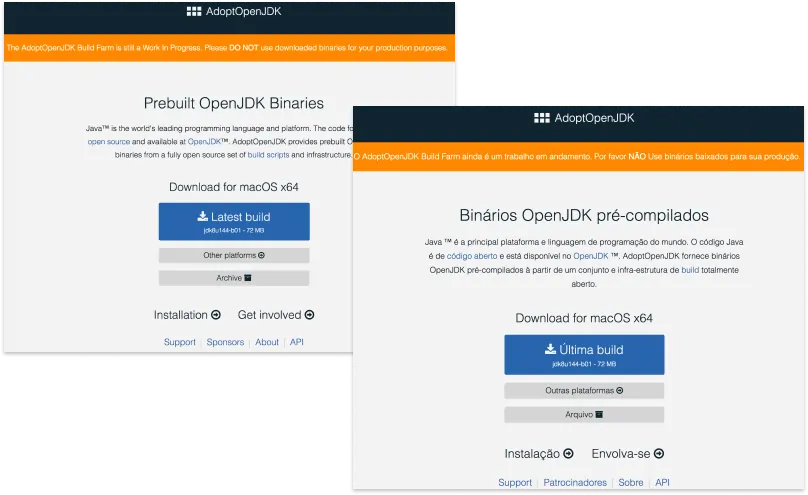
In addition, the level of customer support they received further differentiated Localize as the best solution for AdoptOpenJDK. “There are not many services where you can get a human on the phone the same day,” says Adams.

"We allow a developer to come in and easily see what we are doing, where we are producing it, and how it’s applied. There are no closed doors. We want all developers to share knowledge and make changes. In order to be truly open-source, the platform needs to feel native to each user and be accessible in each user’s preferred language."
George Adams, Backend Engineer & Co-Founder
The Results
Level the playing field for engineers all over the world!

Localize saves time, money, and most importantly, allowed AdoptOpenJDK to level the playing field for engineers all over the world! Contact us today to start translating your application.
“We can do it all with Localize. It has a simple and powerful out of the box solution for non-engineers but can also be extremely customizable if you choose. Localize has a REST API, the frontend SDK, and files. But more importantly, you can use all the tools in seconds. In addition, Java is an incredibly widely used tool in every country. The whole open-source idea is that everyone can work on the same project and pull resources. By making sure everyone can read our content, we are truly open-source which makes our platform even more powerful.”
George Adams, Backend Engineer & Co-Founder
Q & A

Frequently Asked Questions

Learn more about our localizaiton tool.

How did Localize help Code.org reduce localization cycle time?

Localize helped Code.org combine AI translation, targeted human review, in-context editing, glossary support, and real-time publishing in one localization workflow. 

How does Localize keep translations accurate for content students and teachers rely on?

Every translation can go through human review before it is published. Reviewers see it in context on the actual page, so they catch a mistranslated coding term as easily as an off-tone sentence. A shared glossary keeps words like "loop" and "function" consistent across all 29 languages Code.org supports.

What results did Code.org achieve with Localize?

Code.org reduced localization cycle times by 50%+, eliminated publishing delays, and improved cross-language consistency across thousands of lessons.

How does Localize support ongoing localization maintenance?

Localize helps teams detect, translate, review, and publish multilingual updates continuously, so that translated content stays current as source content changes.

Is human review still part of the workflow?

Yes. Code.org uses AI translation for speed and human review where quality, terminology, tone, and cultural relevance matter most.

Ready to keep multilingual content moving faster?

Talk to a Localization Expert about your goals, current workflow, and the best path forward for your team.