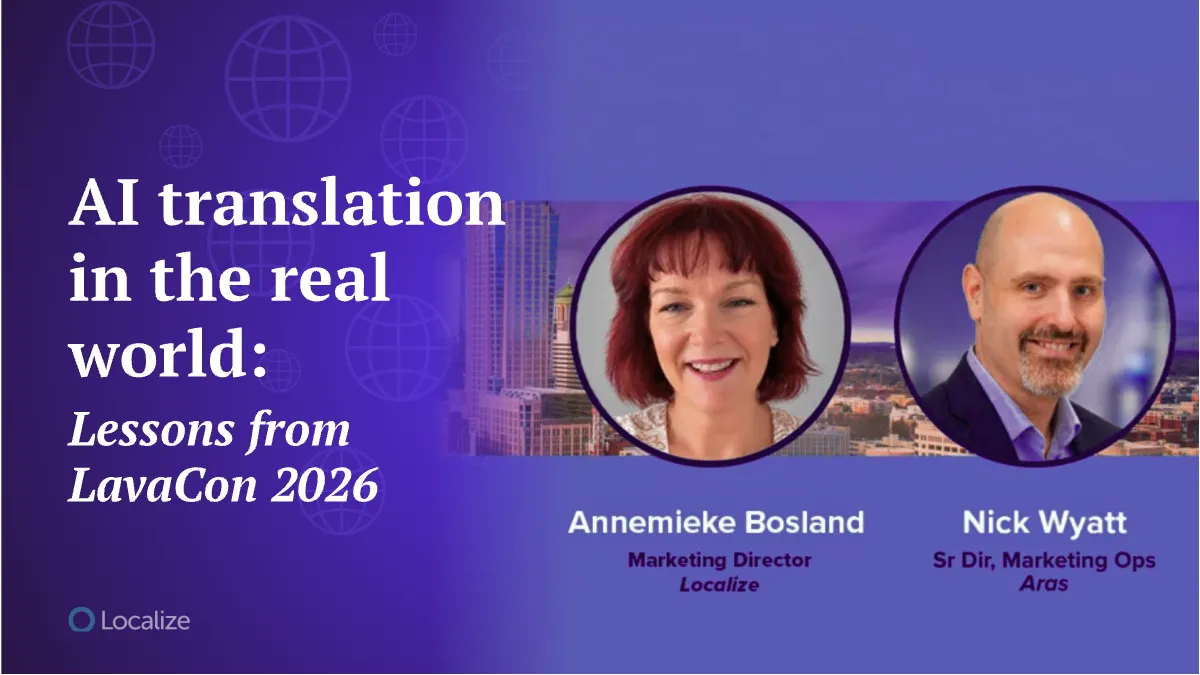
This past week, our very own Annemieke Bosland (Localize’s Head of Marketing) and Nick Wyatt (Aras’s Sr. Director of Marketing Operations) took the stage at LavaCon 2026. There, Nick stated a number: 20 years of content, thousands of pages, and a French and German site falling further behind every quarter. That was the problem Localize was brought in to solve. And at the conference, we got to talk through how we worked together to solve it live with content strategists, documentation managers, and tech comm leaders in the room.
Nick opened with the problem that pushed Aras to change. The company has about 20 years of content behind it, with thousands of pages in English and French and German versions falling further behind each year. Regional field marketers had become part-time translators. A small marketing team was competing against much larger companies, and AI search was changing the math: impressions up, clicks down. Holding ground meant publishing far more content without a matching jump in headcount.
AI writing tools gave Aras the volume in English, but every new English post was one more page their French and German sites couldn't keep up with. Localize, Nick said, was the answer to that problem.
From there, the conversation turned to people. Nick's team now thinks of themselves as editors more than authors. AI agents draft. Humans set direction, provide context, review the output, and decide what gets published. He compared AI to an entry-level employee and how that has given agency to his employees:
“These agents work for them, and that they're … still the human in the loop, right? They are approving what's happening, but it's making them produce more content, more efficiently, and also almost quasi giving them a status bump because now they have a whole team of things working for them rather than just being them.” - Nick Wyatt
We asked how Aras decides where humans stay in the loop: Nick explained that Aras decides how humans stay in the loop based on business impact, customer impact, and visibility:
- High Risk / High Visibility (100% Human Review Required): Content that is highly visible (e.g., the main website navigation), visible to the board or customers, or consequential to a customer's product performance requires 100% human review or is draft-authored before undergoing extensive review.
- Lower Risk (Publish First, Optional Human Review): Content like blog posts or subpages is generated by AI and published immediately without slowing down. Native speakers or team members can conduct a review later if they have time.
- Low Risk / Internal Processes (Automated with Thresholds for Human Review): For automated processes like lead triage, they set specific risk thresholds where only edge cases or exceptions get elevated to a human for review before conversion.
Nick was candid that quality wasn't the only factor. Adoption is as much change management as it is technology. Each region has its own comfort level with AI, and the review model lets every team adopt it at a pace it can accept.
Nick's sharpest example came from outside localization. Aras uses AI for lead triage: it enriches each lead, makes a routing decision, and assigns a score that can be sent to their BDRs.
“[AI] also sped up the time to where the BDRs can reach out to the leads that have come in because we're no longer waiting for a human to do something that's almost immediate.” Nick said. Annemieke connected that pattern to translation. Automate the routine work, decide how far you trust the output, send the exceptions to people, and keep governance over the whole system.
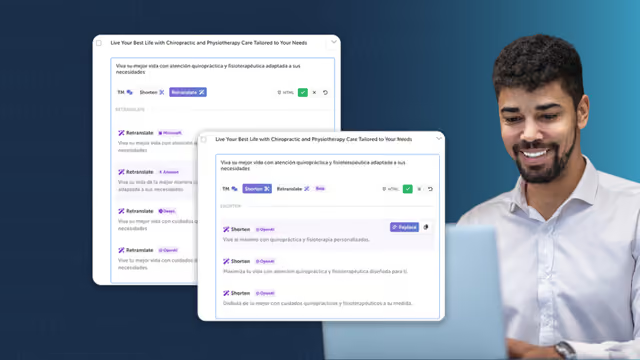
That is why Aras runs localization apart from its other AI tools. Regional reviewers need to see and edit translations in context, on the live page. The business needs an audit trail of what changed and who approved it.
Aras has results to point to. The Chinese site is live, French and German are next, and content output is scaling from about four blog posts a week toward 30. Technical documentation is the next area Aras plans to localize. For a docs-focused audience, Nick's view was encouraging: AI can pull expertise out of subject-matter experts' heads without asking every SME to write from scratch, while writers direct and validate the output.
When asked what advice he would give to someone looking back or figuring out where to start with AI, Nick shared the following key points:
- Focus on People & Change Leadership: He emphasized that "it's really all about people" and that successful implementation comes down to change leadership.
- Leadership Buy-In: It is essential to get buy-in from senior leaders in order to align on vision and process.
- Involve & Empower "Boots on the Ground": He stressed making front-line employees feel part of the process, helping them see the broader vision, and empowering them so they feel included rather than threatened.
- Interactive & Fun Workshops: He described hosting hands-on AI workshops (like giving teams scenarios to build skills and artifacts) to make learning interactive and fun.
- Demonstrate Value for Day-to-Day Jobs: Even technical teams may not naturally experiment with AI on their own time, so showing them directly what AI tools can do helps open up possibilities for their daily workflows.
What stayed with us after the session is how much of Aras’s progress came from decisions about people. Nick’s team knows which content gets a human check and which ships on its own. Their regional reviewers fix translations in context, on the live page, and every change leaves a record. And the people approving AI output now see it as their own team at work.
That trust is what lets a small marketing team run a live Chinese site today and take on French, German, and technical documentation next. If you’re bringing AI into a content or docs program, decide where your people sit in the workflow first, then build the automation around them.
Thank you to Nick, the Aras team, and everyone who joined us at LavaCon!
Is your team publishing more English content than your localized sites can keep up with? Book a demo and we'll show you how Aras is closing that gap.