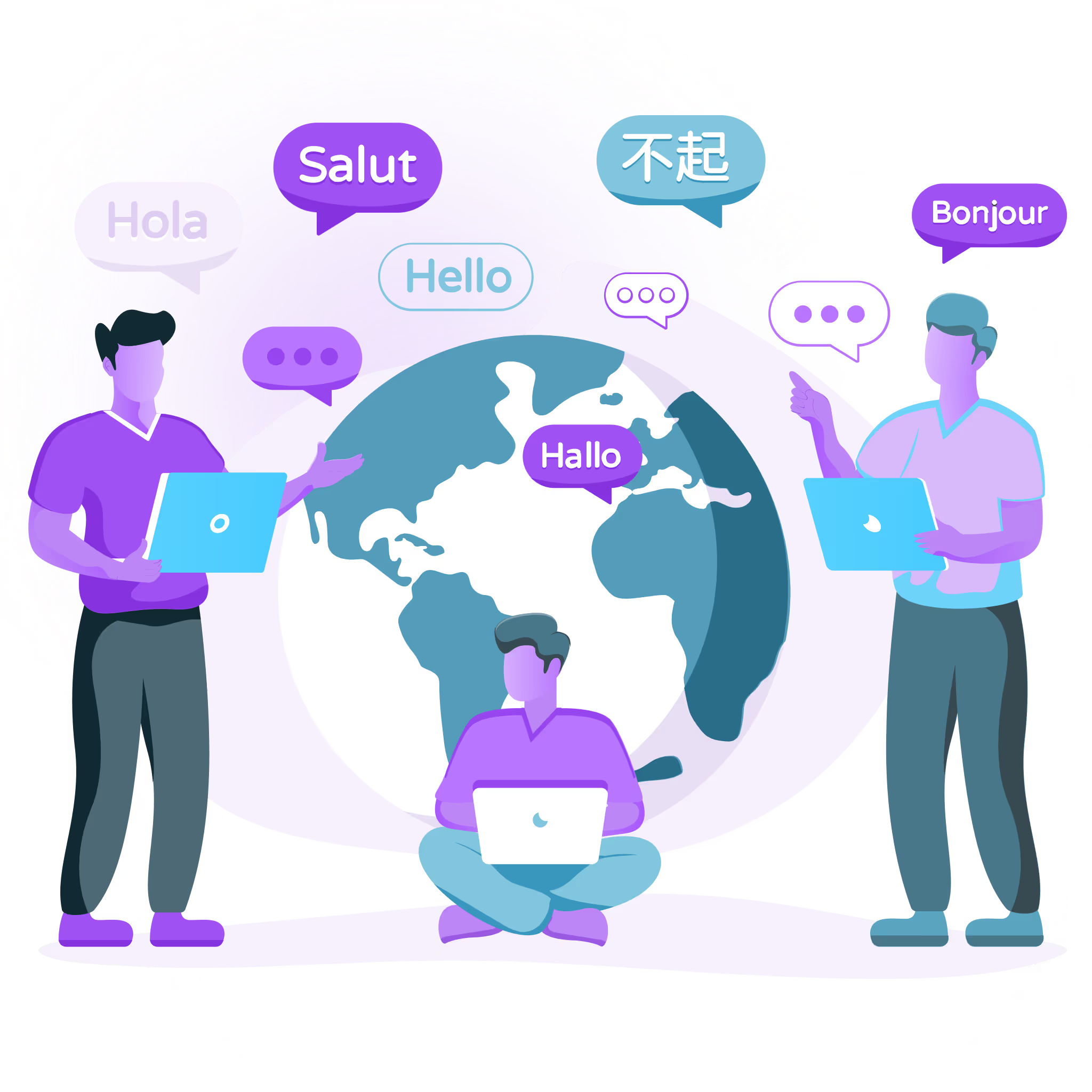
Not too long ago, if you said “AI translation”, people imagined feeding their content to ChatGPT and copying the result or at best asking a human to do a very brief quality check.
And for many, that’s exactly what it was. The results were better than with the traditional Google Translate, especially for longer chunks of text. They were faster than a human translator, something many businesses loved. But reality soon started to change.
Teams that experimented with large language models (LLMs) and machine translation (MT) over the past year learned an important lesson. Ad hoc usage works for quick tests, but it breaks down fast at scale. Quality becomes inconsistent. Brand voice drifts. Teams lose visibility into what was translated, how, and why.
This year, the winners won’t be those simply using AI translation but those running an AI translation system. Routing engines intelligently, measuring quality continuously, and automating the entire localization workflow. Here are the most important trends in AI translation in 2026.
Trend #1: One-engine MT is dying
The default approach for years was very simple: pick one engine and use it everywhere and for everything. Did it work? For a while, and for certain types of content. Sadly, it no longer does.
No single LLM or MT engine performs best across all languages, content types, and risk profiles. Some engines excel at technical documentation but struggle with marketing nuance. Others shine in high-resource languages but degrade quickly in long-tail locales.
In 2025, Localize conducted a blind study to better understand modern localization solutions. The results fully supported the idea that the one-engine translation model at present is a huge mistake.
As a quick example, there were significant differences based on language. Claude proved great in Chinese and Japanese, but not in German. DeepL did well in Spanish, but was less-than-optimal in Chinese.
That’s why in 2026, instead of asking, “Which engine should we choose?”, you need to ask:
- Which engine performs best for this language pair?
- Which model is safest for regulated content?
- Which output meets our quality threshold for this use case?
Modern AI translation systems provide a great solution. They dynamically route content to the right model based on language, domain, and context, an approach that reduces risk, improves output quality, and avoids lock-in as models change.
Trend #2: Translation quality becomes measurable and continuous
Historically, translation quality depended on how good the translator was. When machine translation came into the equation, it relied on spot checks and human intuition. Reviewers would sample content, flag issues, and hope more problems didn’t slip through.
In an AI-first environment, that approach is bound to fail. Especially when you need to translate large volumes of text, relying on verifying a sample here and there is far from enough. You need to look at translation quality as a measurable, continuous signal, and rely on things like automated quality scoring across languages, and benchmarking outputs between engines.
Feedback loops that capture corrections are also critical. When a quality issue appears, the system learns from it, updates the terminology, and redefines style rules. The next translation will automatically use those lessons and will be significantly better.
Trend #3: Brand voice and terminology move upstream
There’s one big mistake many teams make with AI translation. Trying to fix problems after they translated the content. That increases the time it takes until the text is ready. And it increases the chance of mistakes slipping through the cracks.
That’s why a key trend in 2026 will be to ensure brand voice, terminology, and structure are set in stone before translation even happens. What does that mean?
- Centralized glossaries and protected terms.
- Style rules that guide tone and phrasing.
- Variables and placeholders that prevent structural errors.
This achieves one important goal. It prevents issues instead of simply reacting to them. Brand-critical terms remain consistent. Legal language stays intact. UI strings don’t break layouts.
It’s an approach that also reduces review effort. When your inputs are structured and constrained correctly, AI outputs will be more predictable, and far easier to trust.
Trend #4: Translation ≠ localization outcomes
Here's an uncomfortable truth: perfectly translated content can still fail in-market. Good translation gets the words right. But good localization gets the outcome right. And in 2026, that distinction matters more than you think.
SEO is the obvious example. Translating “best project management software” literally into French (“meilleurs logiciels de gestion de projet”) might produce grammatically correct text. But if French users search for “meilleurs outils de gestion de projet” instead, your content stays invisible.
Localized SEO means keyword research, search intent mapping, and regional optimization. Because if you simply focus on word-for-word translation, you can miss local search intent or ignore cultural expectations.
UX considerations matter just as much. Date formats, currency symbols, measurement units, reading direction, and cultural norms all impact whether users engage with your content or bounce immediately. A checkout flow translated into Arabic but still displaying left-to-right will frustrate users, no matter how accurate the translation.
Regional intent goes deeper. Marketing messages that resonate in the United States might feel tone-deaf in Japan. Product positioning that works in Germany might miss the mark in Brazil. Successful localization adapts not just language but context, positioning, and cultural framing.
Innovation in translation technology has made language barriers easier to cross, but crossing them well requires a strategy beyond translation alone.
Trend #5: Localization as a living system
AI models don’t stand still. They update, retrain, and shift behavior constantly. In the blind study we conducted last year, we noticed that the same translation engines produced noticeably different results just a few months apart.
Teams hadn’t changed a single configuration. And yet, reviewers saw clear shifts in quality by language and content type from June until September. This reinforces a hard truth: what works today may not meet the same quality bar tomorrow.
So, what conclusion do we draw here? Continuous evaluation is the only response. Going forward, your team needs to monitor translation quality by language pair, content type, and engine on an ongoing basis.
When performance drops, adjust routing rules. When a new model proves superior, be ready to make the shift. This “living system” approach treats localization infrastructure like any other critical system: monitored, maintained, and optimized continuously.
Trend #6: Governance, auditability, and privacy expectations rise
As AI translation moves deeper into enterprise workflows, expectations around governance rise sharply. Now, we’re not just asking, “Is the translation engine good enough?”. The real question now is, “Can we trust it, control it, and prove it?”.
This final trend of 2026 is all about expecting things like:
- Clear visibility into translation models.
- Audit trails of translated content.
- Controls over where data is processed and stored.
- Strong privacy and compliance guarantees.
Not too long ago, you’d only find these requirements in regulated industries. Now they’re standard for any organization translating customer-facing or sensitive content.
Governance requirements now include understanding which AI models touch which data, who has access, and how sensitive information is handled. Compliance teams want documentation. Legal teams want guarantees. IT teams want controls.
If a platform can’t explain how it makes translation decisions or provide traceability, it will struggle to earn enterprise trust.
What this means for teams in 2026 and beyond
Looking at these 6 trends, there’s one common thread among them. AI translation is no longer a tool you turn on. It’s not one LLM that you feed your text to and cross your fingers hoping for the best. It is now an entire system that you operate.
And that system needs several things. It should route content intelligently, measure quality continuously, and enforce brand and terminology rules. Because AI models are far from static, your system also needs to adapt to these changes and provide transparency and control.
Overwhelming? Not if you have the right translation tools. The Localize AI Suite brings intelligent routing, continuous quality measurement, terminology management, and workflow automation into a unified system. It’s perfect for teams that need more than just raw AI output.
Localize helps organizations orchestrate multiple translation engines, apply quality controls, automate workflows, and maintain governance without slowing you down. Instead of managing translation manually across tools and models, you can centralize decision-making and scale with confidence.
The bottom line? In 2026, AI translation will be faster, more powerful, and more complex than ever before. To succeed, you don’t need to constantly chase the newest model. You need to build systems that can evaluate, adapt, and improve in time.



%20(1).jpg)