Trying to find the right website localization platform? There's a good chance Phrase is already on your shortlist.
It's one of the most established names in the industry, and for plenty of enterprise organizations, it's the right call. But a strong reputation isn't the same thing as a fit for your team.
Phrase runs localization as a structured project: content gets exported, translated, reviewed, and re-imported by people whose job is managing that cycle. Localize skips that cycle entirely. It detects website content automatically as it changes, so your team translates and publishes updates without a file ever leaving the platform.
The right choice comes down to how your team actually works: how often your site changes, who owns the process day to day, and how much complexity you're really managing. Get that wrong and you spend the next year fighting the tool every time you want to ship a new page. This guide is for anyone comparing Localize vs Phrase directly, or just weighing Phrase alternatives more broadly. It breaks down where each platform earns its reputation and how to decide which one fits your team.
What Phrase and Localize are actually built for
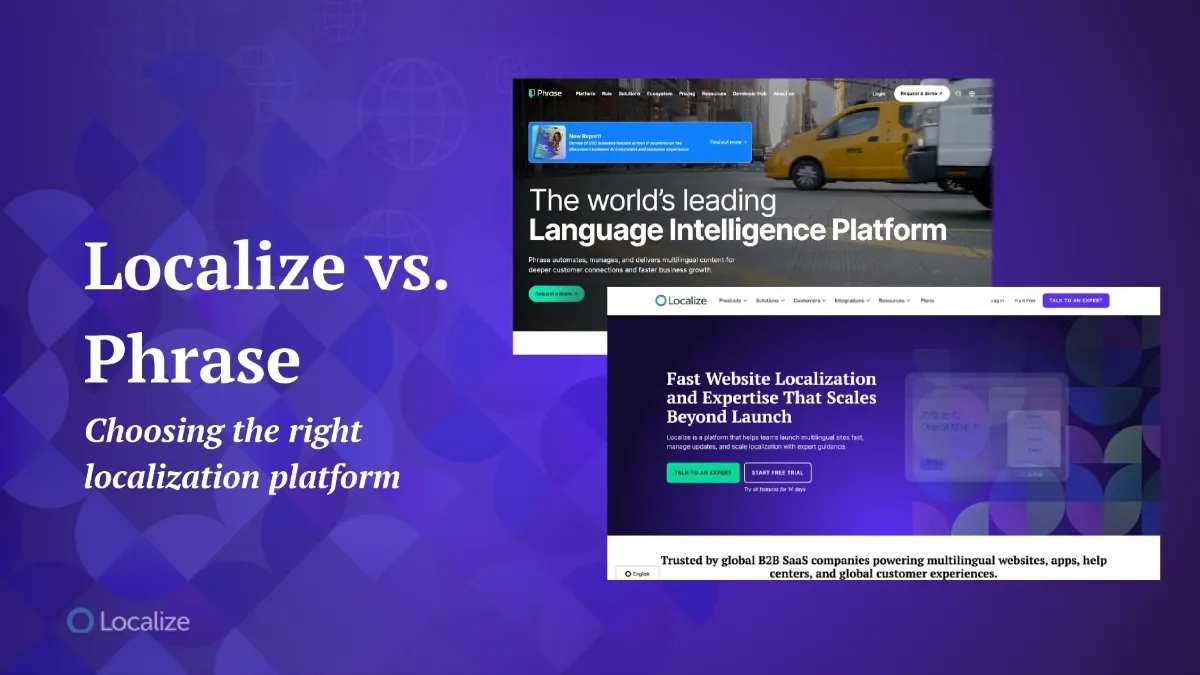
Both platforms help you deliver multilingual experiences, but they're built for different jobs.
Phrase is an enterprise localization platform built around translation management. Its products, including Phrase TMS, Strings, and Studio, are designed for organizations who need a project management tool focused on translation projects.
Localize is a website localization platform, built specifically for websites and web apps. It uses JavaScript to detect on-page content automatically and keeps translations in sync continuously as your site changes. There's no file to export, because there's no file in the workflow to begin with. The content on the page is the source of truth.
Phrase fits organizations that need to manage localization as a formal, auditable process across many content types and many teams. Localize fits teams whose primary localization surface is a website that changes constantly, and who need that surface to stay current without a project cycle attached to every update.
For a quick gut check before the deep dive, here's the Localize vs Phrase comparison at a glance:
The core difference: file-based projects vs. continuous detection
At first glance, both platforms help you translate websites and applications. The difference appears in how new content goes from your source language to a published translation.
Phrase treats localization as a series of structured translation projects. Localize treats it as a continuous publishing process. Subtle distinction? Not exactly. That split is the real fault line in any Localize vs Phrase comparison. It shapes how quickly updates go live, who manages localization day to day, and how much of your team's time gets absorbed by the process itself.
How Phrase's file-based workflow works
With Phrase, localization follows a project-based workflow. Whenever new content is ready, it typically moves through the following process:
- Export strings or pull content through APIs.
- Send the content for translation.
- Review and approve the completed translations.
- Import the translated files back into your application.
- Publish the localized content.
For organizations with dedicated localization teams, this structure offers visibility and control. Multiple stakeholders can review translations before they go live, which suits enterprise environments with formal approval processes. The downside is that every website update becomes another localization project.
A small content change on one page and a large update across many pages move through the same workflow. Every content change needs the same export, translation, review, and import cycle before it goes live in every language.
How Localize's continuous workflow works
Localize takes a different approach to the entire process. After a one-time JavaScript implementation, the platform keeps localization moving continuously:
- Detect new translatable content automatically as it appears on your website.
- Review and edit translations directly in an in-context editor.
- Keep translations synchronized automatically as the source content changes.
- Publish updates without exporting or importing translation files.
With file-based workflows, even small website changes often require another localization cycle before translations are fully synchronized. Localize keeps translated content aligned automatically as the source content changes.
For teams publishing new landing pages, updating pricing, testing messaging, or shipping product announcements every week, localization is just part of the normal publishing workflow. Nobody schedules it separately, and nobody has to manage it as its own project.
Who owns the localization workflow?
This is probably one of the most overlooked questions when you evaluate platforms.
If engineering owns deployment, APIs, and release pipelines, a file-based workflow fits neatly into existing development processes. Phrase provides extensive developer tools, including API access, CLI tools, and CI/CD integrations, which makes it a strong choice for engineering-led localization programs.
But not every company wants developers managing website translations. Marketing teams often own landing pages, product marketing updates, blog content, and campaign launches. Waiting on engineering every time content changes only slows publishing and creates unnecessary bottlenecks.
Localize removes that dependency. It has a no-code setup that lets marketing manage translations directly, without routing every change through an engineering queue. A marketer can paste one line of code, with no development required, then review, edit, and publish a translation the same way they'd edit a landing page, without opening a ticket.
This really comes down to org design:
- Do you want localization to live inside a technical pipeline, managed by developers as part of your release process?
- Or do you want it to live inside the team that's publishing content every day, managed the same way they manage everything else they ship?
Both are legitimate answers. They just lead to two very different platforms, and picking the wrong one means fighting your own org chart for the life of the contract.
When to consider Phrase
Phrase is a well-known name in localization, and it earns that reputation. For organizations running localization at real scale, with dedicated teams and formal vendor relationships, it's built to match.
- Enterprise governance. Phrase holds ISO 27001 certification, alongside SSO and HIPAA compliance, which matters for large organizations with formal security review processes. Localize also covers SSO and HIPAA, but ISO 27001 remains Phrase-specific. That's worth flagging if your compliance team requires that particular certification.
- LSP-managed workflows. Phrase is built around the assumption that specialized vendors handle translations, and its structured, reviewable workflows with clear handoff points support that model well.
- Multimedia localization. Phrase Studio handles video and audio localization at scale, something a web-focused platform usually can't do.
- Depth at scale. Phrase can run dozens of parallel localization projects at once, across product, marketing, documentation, and support content, each with its own team, vendor, and timeline. For a large, cross-functional organization managing that kind of complexity, that depth is a real competitive advantage.
If you see your team in this list, Phrase deserves a serious look.
When to consider Localize
For a lot of SaaS and ecommerce companies searching for Phrase alternatives, the real challenge isn't managing complex translation projects. It's keeping a multilingual website current while the English version changes every week.
That's what Localize is built to solve. Continuous detection keeps translations in sync automatically as your site changes, so localization never falls a project cycle behind your content team. Dynamic variables mean your team translates a phrase once, no matter how many name, date, or order-number variants show up across the site. A confirmation message with a customer's name and order total doesn't need a fresh translation every time those values change.
Multilingual SEO controls, including hreflang tags and language subdirectories, come built in, so search engines can discover your translated pages in each target market from day one. See our advanced SEO controls for the full breakdown. Some teams still hand-roll this with an in-house build, writing their own hreflang and locale-routing logic. That's real engineering time most marketing-led teams don't have to spare, and it's worth weighing against a platform before committing to it. (See our Build vs. Buy Localization guide for that trade-off in full.)
The operational floor is lower across the board, too, which is usually the deciding factor for teams comparing Phrase alternatives in the first place. A marketing team can run Localize without a dedicated localization engineer or an LSP contract, which matters most for mid-market SaaS and ecommerce companies without a large, in-house localization function. That lower floor shows up in how fast a team can actually launch: once the JavaScript snippet is in place, a new market can go live in days, without a vendor onboarding cycle standing in the way.
Localize pairs the no-code setup with a dedicated account and success team that helps prioritize which markets to launch first, configures the initial rollout, and tunes the program as it scales. A marketing team gets that expertise as part of the platform relationship, without adding a full-time localization hire or a separate LSP contract.
Phrase could technically do the job. The real question is whether your team can run it day to day without waiting on another team to do it for them.
Pricing: what each model actually costs you
Pricing is where this comparison gets concrete.
Phrase pricing for teams starts at around $525 per month billed annually for the basic plan, and that figure doesn't include customer support, solutions engineering, or a dedicated account contact. That price reflects the platform's focus on organizations managing large, cross-functional localization programs, and for a company operating at that scale, it's often justified.
But software cost is only one part of the bill. The real question is how much operational effort sits underneath it:
- How much engineering time does the workflow need?
- How many manual review cycles happen for routine website updates?
- How often does marketing wait on localization before a campaign can launch?
Localize's pricing scales with how much of your site you're actually translating, not a rigid per-project fee, and it includes customer support, solutions engineering, and a dedicated account contact at every tier. Teams use that to start with a smaller footprint, prove ROI on one market or language, and expand from there once localization has shown its value internally.
How to decide: a quick framework
A feature list won't settle this, and brand reputation won't either. Answering these four questions will get you closer to your own Localize vs Phrase decision than any spec sheet will.
- How often does your website change? If you're publishing new content every week, a continuous localization workflow generally requires less ongoing effort than managing recurring translation projects.
- Who owns localization? If engineering manages deployments and localization pipelines, a file-based workflow can integrate well with your existing processes. If marketing owns website content and needs to move quickly, reducing engineering dependencies matters more.
- What are you localizing? If your program includes documentation, multimedia assets, support content, and complex enterprise review workflows, Phrase offers capabilities designed for those environments. If your primary focus is your website and web application, Localize offers a more streamlined approach.
- What does growth look like? Some organizations need enterprise governance from day one. Others need to launch multilingual experiences quickly, prove ROI, and expand gradually as international demand grows. The right platform supports how your team works today while leaving room to scale tomorrow.
- Do you want or need localization guidance? Phrase pairs you with an LSP for translation execution, but figuring out what to translate first and how to launch effectively is largely on your team. Localize builds that guidance into the relationship: an account and success team that helps prioritize what to translate, guides the initial launch, and stays on to help the program grow.
Choose the platform that matches your workflow
Phrase and Localize both help organizations deliver multilingual experiences, but the Localize vs Phrase decision really comes down to direction: one manages localization as a project, the other runs it as a continuous part of publishing.
Phrase suits companies running structured, enterprise-scale localization programs with dedicated teams, formal review processes, and broad translation requirements. Localize suits organizations that need a website localization platform to keep pace with continuous publishing, product updates, and global growth.
Skip the feature-by-feature scorecard beyond the table above. The decision comes down to which model matches how your team actually works day to day, and which one your team will still be glad to be running a year from now.
If Localize looks like the fit, book a demo to see it running against your own site and meet the account team who'll help you get there. And if you're planning a broader website localization initiative, download the Website Localization Playbook for a practical framework to build the program around.