
Your company launches in a new market. Traffic arrives, demo requests increase, and everything seems promising. But then growth stalls.
Customers visit the website but don’t convert, and trial users drop off during onboarding. The team starts looking for answers in the marketing, adjusting messaging, launching new campaigns, and refining acquisition strategies.
But the problem is often deeper than marketing. You built the product for one market, then tried to introduce it in another.
The language may have changed, but the experience didn't. Payment flows don't match local buying habits. Onboarding doesn't align with user expectations. Features, messaging, and workflows reflect assumptions from the original market rather than the new one.
This is where many companies understand that localization is a foundational layer.
Language is the visible part of what makes a product feel native. But conversion and retention depend on everything underneath: how people buy, how they evaluate products, and how they expect digital experiences to work.
A localization strategy helps companies adapt to those differences before they become barriers to growth.
This post explores what a localization strategy actually involves, why it matters, and how to build one that supports long-term international expansion.
What is a localization strategy?
A localization strategy is a plan that helps you adapt your product, messaging, and experience to meet the expectations of a new market.
It goes beyond translation, which looks strictly at words, without worrying if the new market will resonate with the same expressions or if keywords make sense.
It is also different from internationalization (i18n), which focuses more on technical aspects, designing and developing software so it can be adapted to various languages.
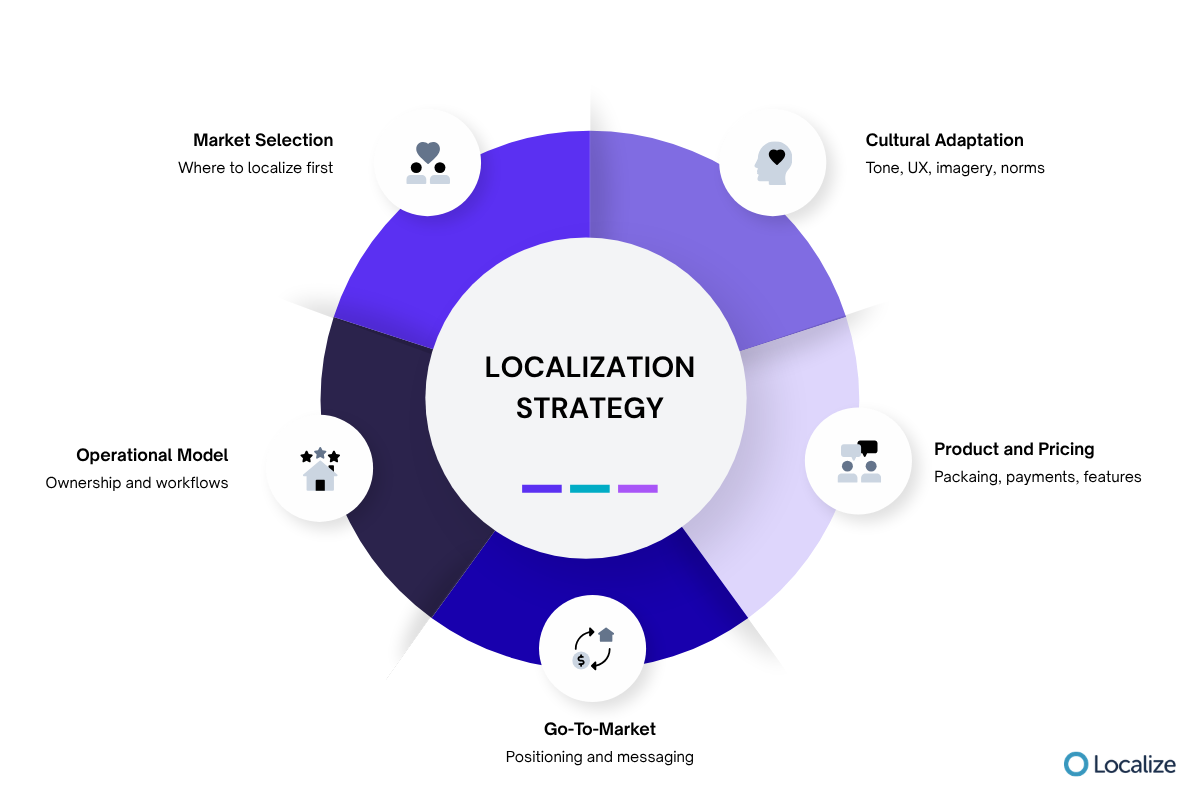
At a strategic level, a localization strategy spans five areas: market selection, cultural adaptation, product and pricing decisions, go-to-market alignment, and operational planning.
Together, these decisions determine where a company expands, how it adapts to local expectations, and how localization scales as the business grows.
Why Localization Strategy Matters More Than Translation
Language alone won’t make a product feel native. And more often than not, users can tell when a product wasn’t actually built for their market.
Take a SaaS company selling subscriptions in the U.S. A credit-card-first checkout flow may feel completely normal to American users. But launch that same experience in markets where customers expect bank transfers, digital wallets, or different billing practices, and users may feel something is off.
Three things matter here.
- Market fit. Cultural adaptation affects whether the product feels native or foreign to buyers. Are you using words and expressions that make sense to them? Is the currency the local one? Does the product comply with local regulations?
Walmart learned this lesson the hard way when it brought U.S. retail practices directly into Germany. It retained customer-service style and employee behavior that worked well in the US. German shoppers, though, reportedly found it uncomfortable or unnatural.
- Revenue. International growth becomes expensive when localization stops at translation. Companies invest in market entry, acquisition, and awareness, only to lose potential customers when the product experience fails to meet local expectations. Language may attract attention, but revenue depends on whether the product, pricing, messaging, and customer experience feel built for the market rather than adapted as an afterthought.
- Competitive positioning. In many markets, the best-localized product wins, even if that’s not necessarily the best product. When multiple products offer similar functionality, the one that feels most familiar, trustworthy, and aligned with local expectations often has the edge. Localization influences how buyers evaluate products, how quickly they adopt them, and whether they view the offering as built for their market or imported from somewhere else.
The Core Components of a Product Localization Strategy
A strong localization strategy is a combination of business decisions that shape how your product enters, adapts to, and grows within a new market.
The companies that succeed internationally usually approach localization as part of product strategy, go-to-market strategy, and customer experience all at once.
Market Selection—Where to Localize First
Many companies assume they should begin with the biggest market first. It’s one of the most common mistakes we see. Large markets may look attractive on paper, but size alone doesn’t guarantee demand, adoption, or even revenue.
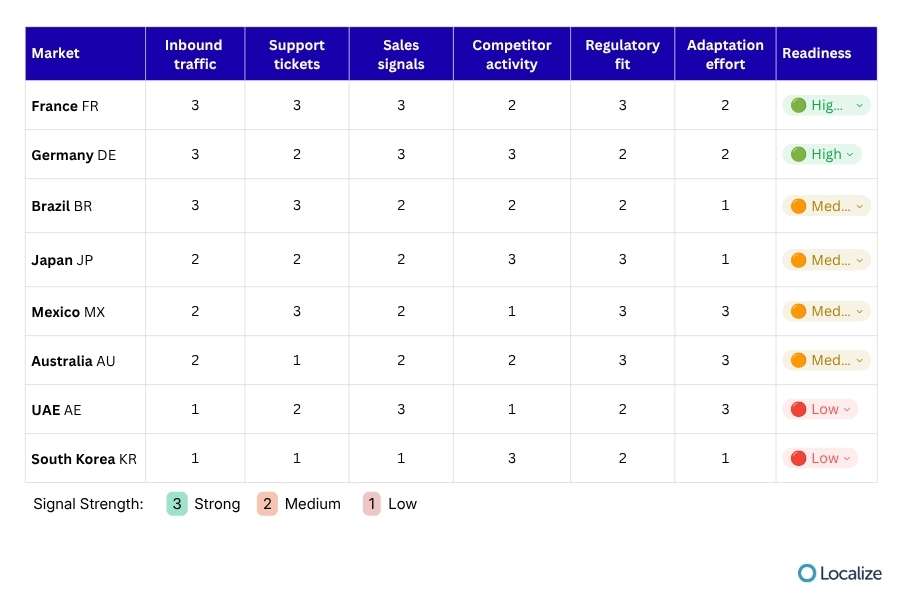
A stronger approach is to look for existing signs of demand already present in your business. These may include:
- International traffic coming from specific regions.
- Support tickets submitted in other languages.
- Inbound sales conversations from international buyers.
- App reviews or customer feedback from underserved markets.
- Competitors already investing in localization within a region.
These signals show you there are buyers who are already trying to engage with your product, even if the current experience isn’t great for them.
For instance, Carry1st, recognized that English alone wouldn’t help them reach users across the African market. Instead of treating Africa as a single audience, they identified growing engagement in French- and Arabic-speaking regions through customer feedback and support interactions, which in turn helped them decide where to localize first.
This is also where many make another costly mistake: defaulting to the largest global markets without qualifying whether the product actually fits local expectations.
A market could have high purchasing power but strong local competitors, different regulatory requirements, or user behaviour that requires significant adaptation.
At the opposite end, a smaller market may bring more opportunities. For instance, it could be easier to enter because demand already exists, and the product requires fewer changes to resonate locally.
You can’t (and shouldn’t) localize everywhere at once. It’s best to identify the markets where localization can remove friction that’s already slowing growth.
Cultural Adaptation
Translation can change the language, but cultural adaptation is what makes it feel native. This includes tone, imagery, colors, onboarding flows, UX conventions, and even the assumptions built into the product itself to ensure everything fits local norms.
Some changes are obvious: date formats, currencies, units of measurement. Others are more subtle but just as important.
A color that signals trust in one culture may signal warning in another. An onboarding flow that feels intuitive to a Western user may feel disorienting to someone whose reading direction, information hierarchy, or decision-making process is different.
Cultural adaptation affects the full customer experience, so it can’t sit only with the translation or the marketing department.
Airbnb is a great example here. A leader in almost every market, it struggled to fit in on the Chinese one, where competitors like Tujia adapted more effectively to local payment systems, customer expectations, and platform behaviors.
If you ignore this, you risk creating products that technically support another language but still feel foreign to local users.
Product and Pricing Localization
Adapting the product goes beyond the interface. Pricing structure, payment methods, packaging, and even feature prioritization may need to shift depending on the market.
A monthly subscription model that works well in the U.S. may underperform in markets where annual billing is the norm, or where local payment infrastructure doesn't support credit cards by default. Similarly, a feature that’s natural in one market may be irrelevant, or actively off-putting, in another.
You don’t have to rebuild the product for every market, but you should make deliberate decisions about what to adapt, what to leave as-is, and what gaps to close.
Go-to-Market and Messaging Alignment
Your positioning in a new market should reflect what matters most to buyers there, which isn't always the same as what drives conversions at home.
The problem your product solves may be real in both markets, but the way buyers talk about it, the urgency they assign to it, and the alternatives they're comparing you against can all be different.
Messaging that resonates with a U.S. enterprise buyer may miss entirely with those in Germany or Japan.
This means localizing not just the language of your marketing, but also its logic.
- Which use cases lead?
- Which proof points carry weight?
- Which objections come up most often?
Operational Model
Localization doesn't scale without ownership. One of the most common breakdowns we see is companies that treat localization as a one-time project rather than an ongoing capability, meaning every new market entry starts from scratch, and every content update creates a backlog.
A sustainable operational model defines:
- Who owns localization decisions.
- How translation workflows connect to product and content releases.
- How you can maintain quality as the program grows.
That usually means cross-functional alignment across product, marketing, engineering, and customer success, with clear accountability at each stage.
Localization Strategy Examples: What Good Looks Like
There’s one common failure pattern you need to look out for when creating your strategy.
Companies localize their marketing websites, generate international pipelines, and then watch as conversions stall. The trial, the onboarding, the in-app experience, everything except a few pages on the website, is in English. Buyers showed up because they thought the product was meant for them, but everything after told them it actually wasn’t.
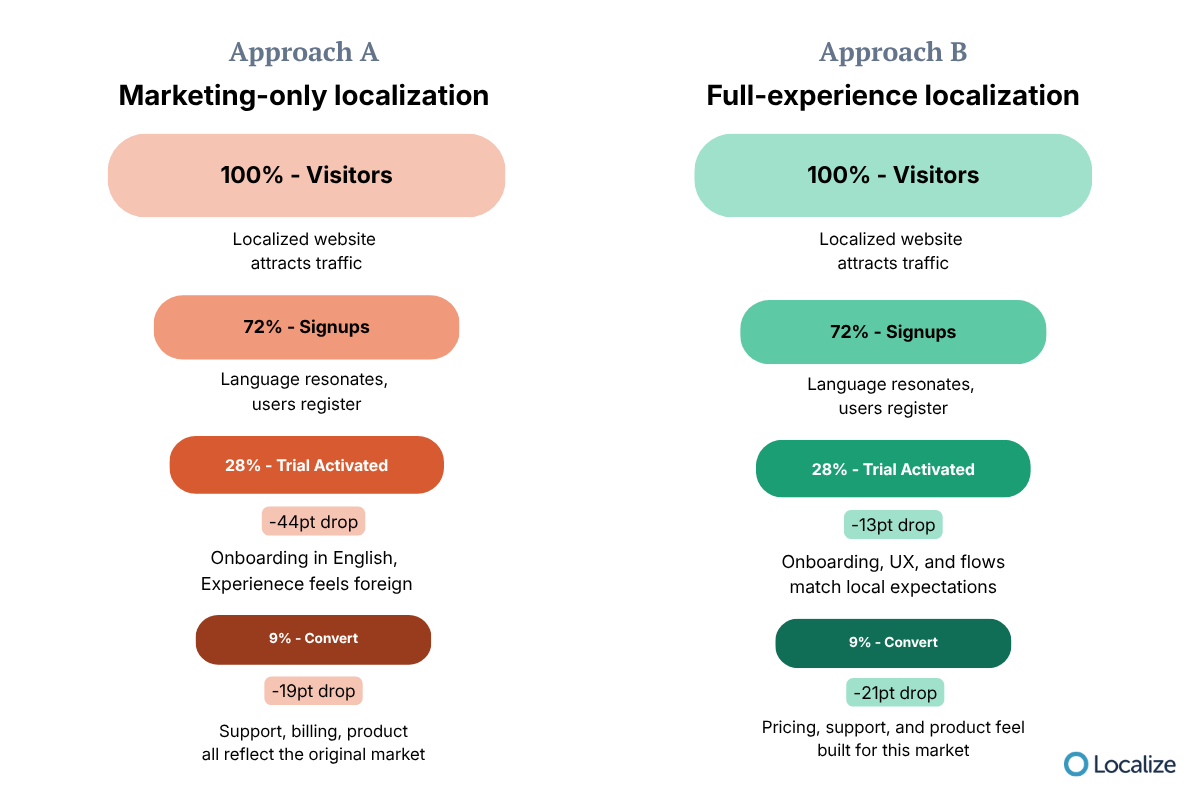
This is one of the most common and costly localization mistakes: investing in acquisition-layer localization without extending it through the full customer experience. Because being successful in a new market is the result of several well-implemented steps.
Let’s look at some successful localization strategy examples to understand what works in practice.
bswift: Making Language Support a Sales Asset
A B2B SaaS company in the employee benefits space, bswift faced a specific problem in their sales process. When prospects asked whether the platform could support their employees’ languages, bswift couldn’t say ‘yes’ quickly enough.
For a product that employees interact with during high-stakes moments like enrollment, that hesitation was problematic.
And they soon realized that a better translation tool wasn’t the answer. Language coverage had to become something sales could confidently commit to on the spot instead of asking the engineering department.
The result: implementation time dropped from weeks to under a day, the platform now supports more than 150 languages, and the team can demo the product in any language on demand.
Understanding this changed how they looked at localization solutions. They went from a slow, manual process to one where implementation time dropped from weeks to less than a day, and the team could demo the product in any language on demand.
JOOR: Localizing Both Sides of the Transaction
JOOR operates a wholesale platform that connects fashion brands and retailers across global markets. As they expanded internationally, the strategic question they had to answer was: what does it actually mean to localize a two-sided marketplace?
The simple answer would’ve been to localize the marketing layer, which included the website and the acquisition flow, and leave the rest for later. But they rejected this idea as they felt that in a transaction platform, both parties need to feel at home.
A brand operating in French and a retailer operating in Japanese are both using the same platform to do business together. If either side of that experience feels foreign, the transaction suffers.
That decision led them to localize both the brand interface and the retailer interface across nine languages. The lesson to learn here is about where the real friction lies. For JOOR, it was inside the product, where deals actually get done.

How to Build a Localization Strategy That Scales
Knowing the basics and actually building a successful product localization strategy are two different things.
Start With One or Two Markets
Try to localize in five markets at the same time, and you’ll likely do all of it poorly. A phased approach lets you develop the operational muscle, identify what you need to adapt, and show business results before expanding.
Pick your highest-signal markets first. Localize them fully across the product experience and measure what changes. This gives you a repeatable model to carry into the next market entry.
For example, define upfront what success looks like for the pilot market. That might include conversion rates, trial activation, customer retention, or support volume. Once the model works in one market, you'll have data to guide future expansion decisions.
Build Cross-Functional Ownership
Localization concerns far more teams than just translation.
- Product owns the in-app experience.
- Marketing owns the website and campaigns.
- Engineering owns the technical infrastructure.
- Customer success owns post-sales communication.
If your product localization strategy rests entirely on the shoulders of one or two teams, the other layers will lag.
An effective program defines clear ownership at each stage and creates the connective tissue between teams so that a new market entry doesn't mean starting from scratch.
For instance, many successful programs assign a localization owner who coordinates priorities across departments and ensures launches, content updates, and product releases follow the same localization standards.
Shift to Program Thinking
A project has a start and an end, so if you see localization as that, you likely see a moment in time when you’ll no longer need to work on it. But markets and products change, and content updates continuously.
If you want to scale globally, you need to think of localization as a program that you build into your day-to-day activities. That usually means automation, clear workflows for ongoing content, and a platform that keeps up with the pace of your releases.
That usually means building localization into your content publishing workflow, not treating it as a downstream step. Every new page, campaign, or product update should trigger a localization task—not a separate localization sprint months later.
Common Localization Strategy Mistakes to Avoid
Even well-resourced teams make the same errors. Here are the ones that tend to be the most expensive.
- Treating all markets as equivalent. A localization strategy for France is not a template for Brazil. Market entry decisions, cultural adaptation, and operational requirements all vary.
- Localizing marketing but not the product experience. Many companies localize websites and campaigns first, then discover that onboarding, support, and product experiences still reflect the original market. International demand may grow, but conversion stalls when the rest of the customer journey feels foreign.
- Treating localization as a departmental task instead of a business priority. This is often the root cause behind localization failures. When localization sits entirely within one team, it is under-resourced, disconnected from product decisions, and treated as a one-time project rather than an ongoing capability. The programs that scale typically have executive sponsorship and cross-functional ownership.
Next Steps
The companies that win in international markets have one thing in common: they treat localization as a strategic investment, not an operational afterthought. They make deliberate decisions about which markets to enter, what to adapt, and how to build a program that sustains growth as they scale.
If you're ready to move from thinking about international expansion to building the program that makes it work, the next step is understanding how to operationalize your localization strategy.
Our Website Localization Playbook gives you the full framework for building and scaling a localization program, with the detail you need to actually put it in motion.
Or, if you'd rather talk through your specific market and program goals first, book a strategy call with our team.