Your team has decided it's time to localize. Maybe you're expanding into a new market, sales wants multilingual content, or maybe you're seeing product adoption grow outside English-speaking regions.
Then engineering raises a question that feels reasonable: do you really need a localization platform? Couldn't you build this with AI coding tools in a few days? Can’t you just vibe code it?
In 2026, that argument is more compelling than it’s ever been. A working prototype is available in a single sprint. On paper, it looks cheaper than a platform subscription.
The spreadsheet is missing most of the cost. Nimdzi's 2026 research with more than 100 enterprise localization leaders is unambiguous on this: the line between a working proof-of-concept and a production-grade, sustainable platform is exactly where in-house builds stall — and where the real costs begin. Employee hours are buried in maintenance. Engineering capacity pulled away from product work. An approvals process that doesn't scale. A scaling ceiling that hits right when international growth demands more.
This post makes that cost visible.
What is the build vs. buy decision in localization?
The build vs. buy localization decision is a resource allocation decision. Does your team build and maintain translation infrastructure internally, or adopt a purpose-built platform to handle it?
The choice determines how your engineering, marketing, and product teams spend their time — not just how much you spend on software.
You could build the localization workflow in-house, but the more useful question is capacity: what does each path ask of your people, and for how long?
Why teams consider building localization in-house
The build argument has real logic behind it. If there's a possibility to save costs, while doing everything in-house, thus having full control over your tools, why not take it?
Understanding why teams find it appealing is the first step to evaluating it honestly.
Total customization
Some workflows genuinely don't map to off-the-shelf solutions. Unique publishing requirements, internal review processes, compliance constraints, or technical architectures can all make a purpose-built platform feel like a poor fit. For teams that already maintain substantial internal tooling, building localization feels like a natural extension.
Perceived cost savings
A platform subscription has a visible price. An internal build appears to cost only the engineering time already budgeted. When a developer can demo a working prototype in days, the math looks straightforward: if we can do it ourselves, why pay for software?
The comparison stops at the prototype stage and rarely accounts for what operating and maintaining your localization platform costs over time.
Strategic control
Some teams prefer to own critical infrastructure rather than depend on a vendor. Building internally eliminates concerns about pricing changes, roadmap decisions, and lock-in limitations. Your team owns the system and can modify it on their schedule.
Each of these arguments focuses on the decision to build while leaving out the cost of what comes after.
The hidden costs of building localization in-house
The initial build is visible. Everyone sees the sprint, the ticket, and the prototype. The ongoing work is much harder to measure because it gets distributed across multiple teams and absorbed into existing workloads. Over time, localization stops being a project and becomes an operational system that requires constant attention. These are the costs that rarely make it into the original spreadsheet.
The initial build is the easy part
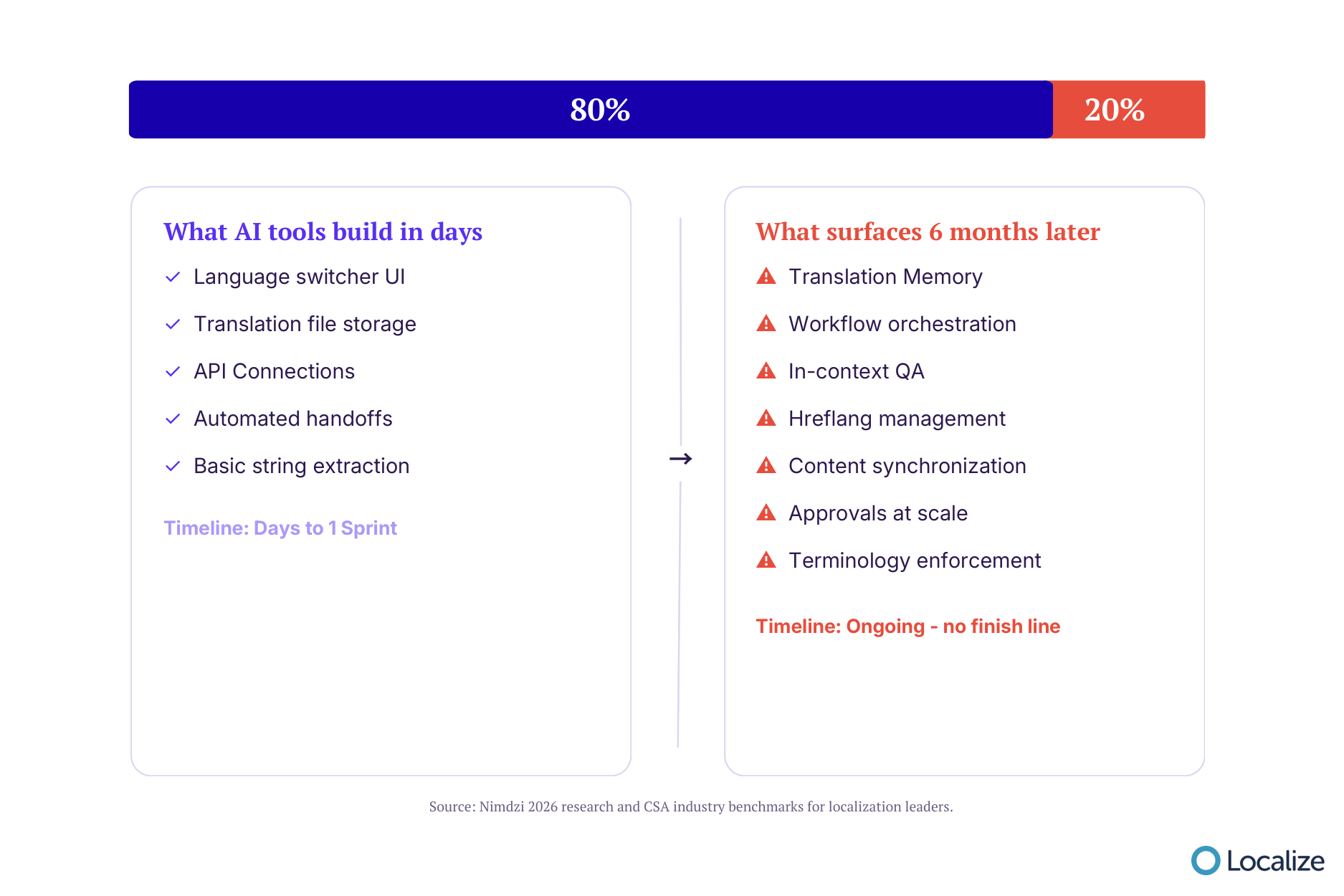
AI coding tools have made the first 80% faster than ever. An engineering team can build a functional localization workflow — language switchers, translation file storage, API connections, automated handoffs — in days.
The final 20% is a different problem entirely. As Nimdzi (2026) points out, the gap between a working proof of concept and a production-grade system that can scale with your company is exactly where in-house builds stall.
Translation memory, workflow orchestration, in-context QA, hreflang management, and content synchronization don't surface in the prototype. They surface six months after it ships. By then, teams have already committed to owning the infrastructure.
All of these problems — string management, workflow orchestration, QA — aren’t new. Purpose-built platforms have been solving them in production for years across thousands of teams. Your engineers aren’t being asked to innovate —they are being asked to resolve problems that have already been solved.
What a localization build actually involves (beyond your prototype)
The original ticket was straightforward: build a way to localize your website or product into multiple languages and markets. A production-grade localization platform requires much more than that.
At a minimum, teams typically need to account for five ongoing responsibilities:
- Content detection and terminology management: Automatically detect new and modified strings across the codebase and content management systems (CMS), maintain a translation memory to avoid repeatedly retranslating identical content, and enforce glossary rules to keep brand terminology consistent across markets.
- Workflow orchestration: Route content to the right translator or machine translation engine, manage review stages, track approvals, and handle rejected translations without creating a chain of manual follow-ups.
- Quality assurance: Review translations in context, not just in translation files. Many issues only become visible inside the actual product interface, including text expansion, layout breaks, truncated buttons, and rendering errors.
- SEO management: Implement hreflang tags correctly so search engines understand which language version to serve to each audience.
- Content synchronization: Every time your source content changes, translated versions need to be flagged, updated, and republished without relying on someone remembering to manually restart the process.
Employee hours: the budget line no one tracks
Building localization in-house doesn't eliminate work. It simply redistributes it to whoever is available.
Someone has to extract strings, coordinate translations, manage files, review content, approve changes, and publish updates.
Those responsibilities rarely belong to a single person. Those responsibilities are spread across marketing managers, developers, product managers, and anyone else involved in content production. They don't appear as a new budget line because they're absorbed into existing salaries.
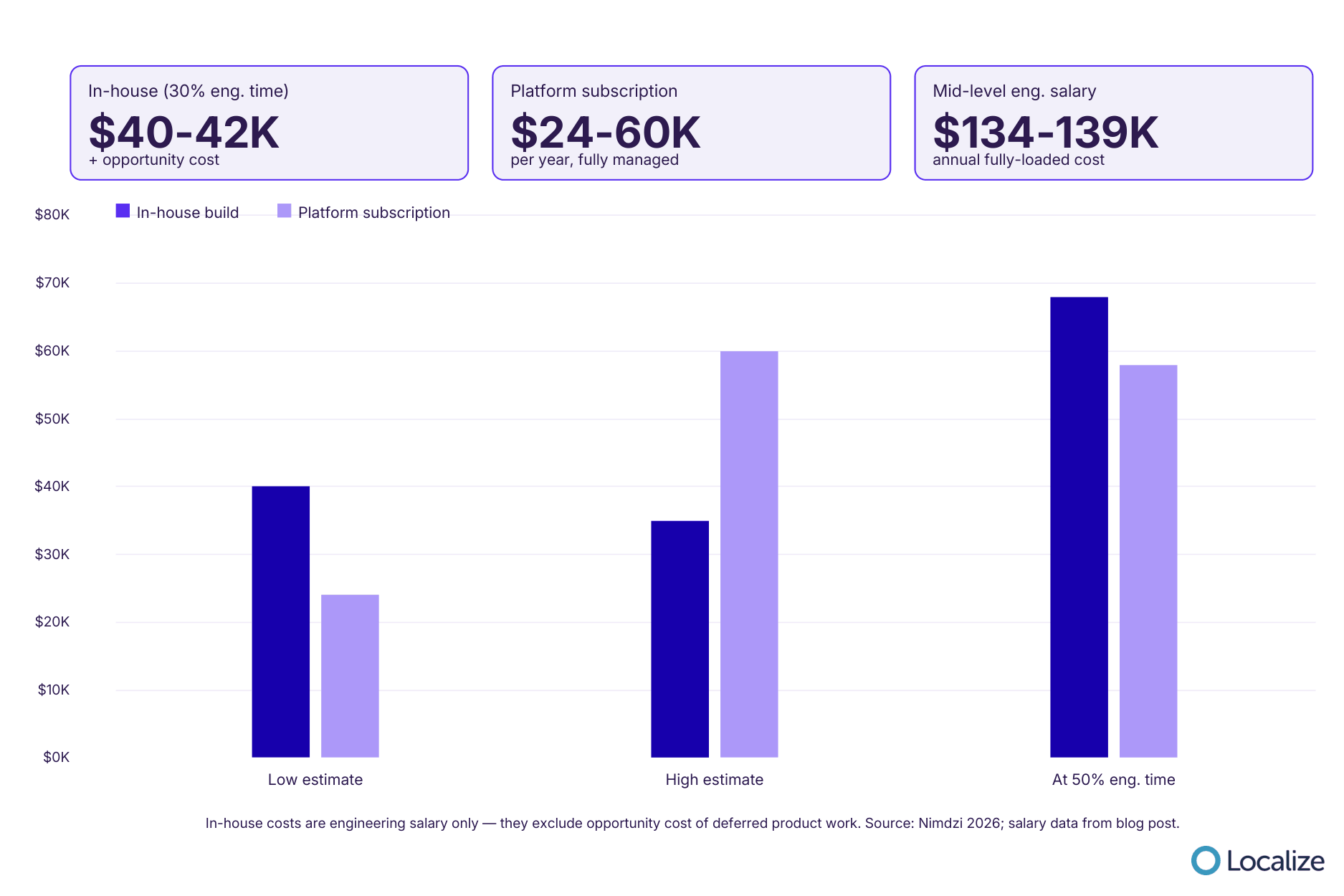
Imagine your team managing a 50-page website across three languages. A routine update cycle can consume hours of coordination, review, and republishing every time source content changes. A mid-level software engineer costs $134–139K per year.
A purpose-built platform can run $2–5K per month. When teams account for actual hours spent (and not just the prototype sprint), the subscription pays for itself faster than the spreadsheet suggested.
Task-shifting: what your engineers stop building
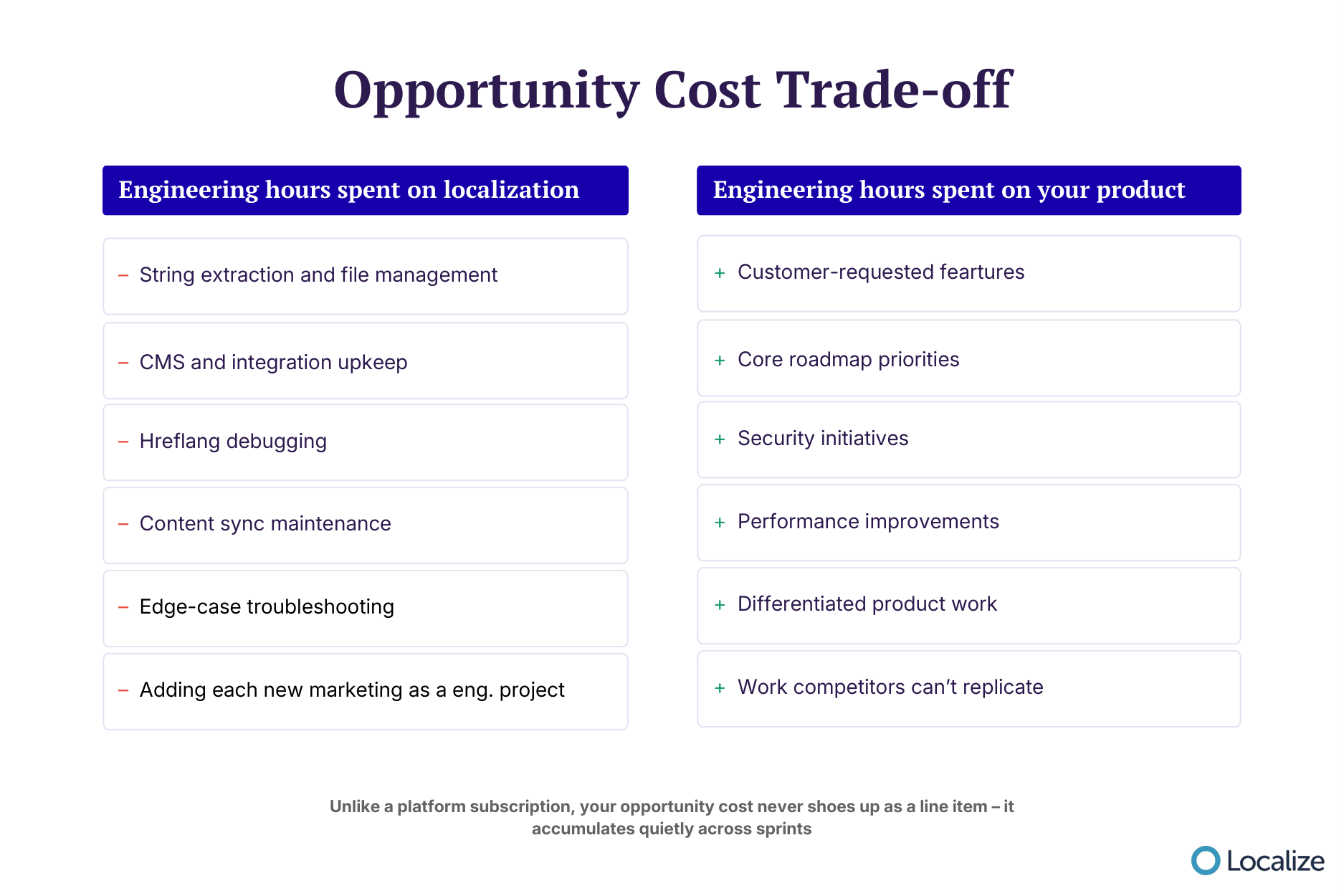
Every engineering hour you invest in building your own localization platform is an hour not spent on your product. That's a hidden opportunity cost that many organizations underestimate.
The question isn't whether your engineers can build a localization workflow. The question is what stops moving while they do.
For mid-market SaaS teams with limited engineering bandwidth, localization infrastructure often competes directly with:
- Product improvements
- Customer-requested features
- Security initiatives
- Core roadmap priorities.
Owning your own localization infrastructure is not a competitive advantage. The companies winning in international markets aren't the ones that built their own translation management system. The winners are the ones who kept shipping products while a platform handled the operational complexity.
Maintenance: the build that never ends
An in-house localization system is not a project with a finish line. It's a product that requires continuous ownership.
Every website redesign, CMS update, product release, or market expansion creates more work. Integrations need maintenance, workflows need adjustments, and edge cases need troubleshooting. Most organizations don't assign a dedicated owner, so maintenance becomes everyone’s secondary responsibility — which means it gets deprioritized.
Sound familiar?
In time, translation issues start to appear. Translation drift follows. Source content updates without corresponding changes in translated versions. The German landing page goes stale. The French product page breaks. Your non-English experiences quietly degrade without anyone noticing until it's a bigger problem than a maintenance cycle.
The approvals bottleneck
Localization is more than translation. Someone needs to approve each version. Informal approval processes work at low volume — one language and a handful of pages - but when the content volume increases, they create two equally bad outcomes: publishing without sufficient review, or delaying launches until someone with the right language expertise becomes available.
Who reviews the German version? Who signs off on French product updates? Who catches cultural nuances before content goes live? Without a structured process, these questions get answered ad hoc — or not at all.
Scaling: where in-house builds break
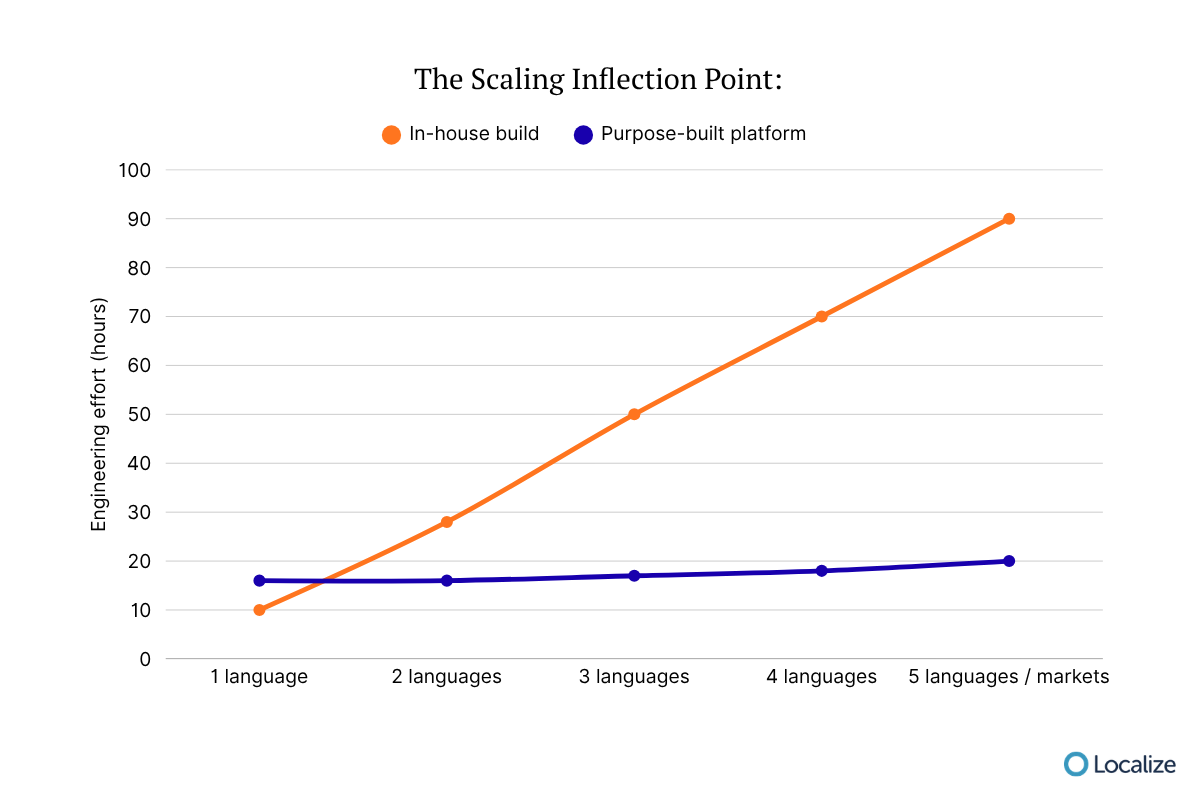
Here is where teams finally discover the true cost of building.
An in-house solution often handles its original use case. Translating one website into one additional language is manageable. When you start adding additional markets, new content types, or increase your publishing velocity, the problems become obvious.
Each new language risks becoming a new engineering project. A new CMS integration requires another build cycle. Supporting multiple teams introduces additional approval layers.
At this point, expansions become more about redevelopment than configuration — and it typically happens at the exact moment the business needs localization to become faster, not slower.
If your engineers are already balancing product priorities, growth initiatives, and customer requests, it may be worth seeing what a purpose-built platform removes from their plate.
See what your team gets back when localization runs itself.
When does building in-house make sense?
Building isn't always the wrong call. But the conditions that make it the right call are rarer than most teams assume. Three need to be true simultaneously:
1. Your requirements are truly unique
If you’re operating in highly specialized environments (complex compliance requirements, deeply customized technology stacks, workflows with no existing platform support), you can justify a build. This scenario is more common in large enterprises with highly customized technology.
Most teams discover that the challenges they're facing — multilingual content updates, review workflows, terminology management, content sync — are standard localization problems that established platforms already solve.
2. You have dedicated localization expertise
Building software and building a localization infrastructure are two different things. AI coding tools have lowered the barrier to creating applications, but they haven't replaced domain expertise.
Production localization requires teams that understand the technical, operational, and linguistic dimensions of the problem — and those resources need to be dedicated to the initiative — not borrowed from other priorities.
3. You're prepared to own a product, not complete a project
This is the deciding factor. An in-house localization solution requires ongoing investment, ownership, documentation, maintenance, and support.
Leadership teams need to ask one simple question: Are we prepared to operate localization infrastructure indefinitely?
For many mid-market SaaS organizations, the answer is no. If you've reached that conclusion and are ready to plan expansion, start with how to choose which markets to localize into first.
What buying actually gets you
A purpose-built platform isn’t a shortcut — it’s the accumulated result of solving the same problems that are about to be encountered repeatedly, at production scale.
What you recover when you buy is the cost of re-solving them yourself.
Every capability a purpose-built localization platform provides removes operational work from your internal teams — and returns that capacity to the work that actually differentiates your business.
Automatic source detection means your team stops auditing codebases and CMSs for new or changed content. It gets flagged and routed without anyone initiating the process.
Structured review workflows replace the spreadsheets, email threads, and ad hoc approval chains that slow localization down and let quality issues slip through.
Translation memory and glossary enforcement keep terminology consistent across every market without anyone policing it manually — the system enforces it.
Scalable architecture turns market expansion into a configuration exercise. Adding a language is a setting, not a sprint. Adding a market doesn't open a new engineering ticket.
But the capabilities list undersells what you’re actually getting. When you buy a purpose-built platform, you're also buying the judgment of people whose entire job is localization — support teams who've debugged hreflang errors at scale, rebuilt broken content sync workflows, and handled the edge cases your build ticket didn't mention. That expertise is baked into the product design, the QA tooling, and the onboarding. It doesn't exist in a prototype.
Your marketing, product, and engineering teams still make strategic decisions, review content, and set quality standards. The difference is they're spending that time on localization outcomes rather than localization administration — and they have experts behind them when something breaks.
Building a localization platform yourself means you own the infrastructure. It doesn't mean you own the expertise. A platform built across hundreds of teams carries something an internal sprint can't produce — the accumulated judgment of people who have debugged the edge cases, rebuilt broken workflows, and navigated the localization challenges your team hasn't encountered yet.
For most mid-market SaaS organizations, localization isn't a core competency. Acquiring the technology and the operational expertise to run it at production scale is a significant investment in a capability that a purpose-built platform has already developed.
The question worth asking isn't whether your team can build it. It's whether building it is where that investment should go.
The real cost is building, not owning
AI tools have changed the build argument. But they haven’t changed the answer.
Your team can probably build a localization workflow. Your prototype will work. Then you need someone to maintain it. Your teams will need to update it when the CMS changes, fix it when a new market exposes an edge case, and explain to a frustrated marketing manager why the French homepage is six weeks out of date. That someone almost certainly has another job title.
Ultimately, the build vs. buy decision is about resource allocation.
Every hour your engineers spend on localization infrastructure is an hour they aren't spending on the work that actually differentiates your business. And unlike a platform subscription, that cost never shows up as a line item — it just quietly accumulates across sprints, headcount, and delayed roadmap priorities.
Your engineers can build a localization system. What they can't easily acquire is the localization judgment to run it.
Do they know which MT output is fluent but culturally off? Or when a translated CTA will convert in French but land wrong in German? Knowing whether hreflang is misconfigured in a way that looks clean in a file but quietly kills your search rankings in a new market.
That knowledge comes from working inside localization programs across hundreds of teams, in dozens of markets, over years — not from a sprint, however well-executed. The teams that get localization right aren't just the ones who stopped rebuilding solved infrastructure. "They're the ones who had localization experts in their corner from day one — people who've seen every failure mode and know exactly what right looks like."
See what your team gets back when localization runs itself.
Not ready for a strategy call yet? Download our Website Localization Playbook for a practical guide to building a localization program that scales.