
For most of the past decade, AI translation strategy has been a relatively static decision. Teams selected a provider, often Google Translate or DeepL, configured it once, and assumed quality would steadily improve over time.
That assumption no longer holds.
AI translation has entered a phase of rapid, uneven evolution. New models appear all the time, performance shifts by language and content type, and quality gains in one area can coincide with regressions in another.
In this environment, choosing a single engine and hoping for the best becomes a true, measurable risk.
To better understand how today’s leading AI translation systems actually perform under real-world conditions, Localize conducted two independent, proprietary blind studies in 2025.
Rather than testing artificial benchmarks or vendor-curated examples, the studies were designed to mirror the kinds of content enterprises translate every day, and to evaluate quality without brand bias.
The findings point to a fundamental shift in how localization teams should think about AI translation in 2026 and beyond.
Why We Ran a Blind Study on AI Translation
The Limits of Vendor Claims and Static Benchmarks
Most public comparisons of translation engines rely on:
- automated metrics,
- narrow test sets,
- or vendor-controlled demonstrations.
While useful for basic validation, these approaches don’t reflect how translation quality behaves in production environments. Here, content varies widely in structure, tone, and intent, so a one-size-fits-all approach will never work.
At the same time, enterprise teams rarely have the resources to run large-scale, unbiased evaluations themselves. As a result, engine choices are often driven by:
- legacy decisions,
- perceived “safe defaults,”
- or anecdotal feedback from individual markets.
These are good criteria. Until you realize you work in a landscape where models change monthly, or even weekly, which means these shortcuts quickly become liabilities.
Why Blind Evaluation Matters
There’s one truth you need to keep in mind. Translation quality is inherently subjective. Even experienced linguists can be influenced, consciously or not, by expectations about a provider’s reputation or typical strengths.
A blind study removes that influence.
Without revealing the source, blind evaluations ask native speakers to rate translations on fluency, precision, and meaning preservation. This makes it possible to assess quality as it’s actually perceived, without the influence of brand expectations or reputation.
The goal of Localize’s blind study was not to declare a universal “winner,” but to generate reliable, data-backed insight into:
- where different engines excel,
- where they struggle,
- and how those patterns change over time.
How the Study Was Designed
As this was a blind study, we anonymized all translation outputs before evaluation. Translators didn’t know:
- which engine produced a given translation,
- whether it came from a traditional MT system or an LLM,
- or how other engines performed on the same phrase.
Then, each translation was evaluated independently to minimize cross-contamination or anchoring effects.
Engines and Models Evaluated
Across the June and September 2025 studies, Localize evaluated:
Traditional MT engines:
- Google (NMT)
- DeepL
- Amazon
- Microsoft
LLM-based translation systems:
- OpenAI (GPT-4.0 Mini)
- Claude (Sonnet 3.5)
- Google LLM variants
- Google Translate LLM (Basic)
- Google Translate LLM (Adaptive)
The selection isn’t an exhaustive catalog of every available model. But it reflects the engines most commonly encountered in enterprise localization workflows today.
Languages and Content Types
We included 6 strategic languages in our study:
- Spanish (ES)
- French (FR)
- Japanese (JA)
- Italian (IT)
- German (DE)
- Chinese (ZH)
For each language, we selected roughly 40 phrases to span:
- simple declarative sentences,
- UI-style strings with variables,
- longer, context-heavy paragraphs,
- and deliberately difficult idiomatic or ambiguous constructions.
This mix was intentional. Testing only “easy” sentences hides the failure modes that matter most in production localization.
Evaluation Criteria and Scoring
Native linguists scored each translation on:
- fluency,
- accuracy,
- and meaning preservation.
The September study used a 1–5 scale to reduce variance and improve interpretability, while the June study used a 1–10 scale. Directional comparisons between the two were normalized to identify improvement, regression, and volatility trends over time.
What we didn't test (and why): We focused on text translation, not document formatting, multimedia localization, or real-time speech translation. We also didn't test domain-specific terminology at scale, as legal, medical, or highly technical content would require separate evaluation. Our goal was to understand general-purpose translation quality across the content types most organizations translate daily.
Key Findings at a Glance
Across both studies, several patterns emerged.
- LLM-based engines outperformed traditional neural machine translation across all languages. OpenAI (4.75/5) and Claude (4.73/5) led the rankings, followed by a competitive middle tier of traditional engines.
- Performance varied significantly by language and content type. No engine excelled universally. LLMs showed particular strength in Japanese, Chinese, and Italian, while traditional engines remained reliable for European languages with simpler grammatical structures.
- Google underperformed expectations, even with LLM variants. Despite widespread adoption, Google NMT (4.49/5) ranked lowest overall, and its LLM variants showed only modest improvements, still trailing competitors by meaningful margins.
- Quality volatility remains a real risk. Comparing the June and September results revealed engines improve and regress unpredictably. Some language-engine pairs improved significantly; others declined, highlighting the need for continuous evaluation rather than one-time decisions.
- Cost and quality don't always correlate. Claude delivered top-tier performance at the lowest cost per character ($0.25 per 50,000 characters), while Google's most expensive LLM variant ($2.50) underperformed cheaper alternatives.
Insight #1: AI Translation Quality Is No Longer the Main Bottleneck
When aggregated across all six languages in the September study, the highest-performing engines were LLM-based:
- OpenAI GPT-4.0 Mini: 4.75
- Claude Sonnet 3.5: 4.73
Traditional MT engines clustered just below:
- DeepL: 4.63
- Amazon: 4.62
- Microsoft: 4.61
Google’s engines, both NMT and LLM variants, ranked lowest in aggregate scores.
The most surprising finding wasn't which engine performed best, but how close the top performers came to human-level quality across routine content.
For straightforward sentences, clear instructions, and well-structured paragraphs, the gap between professional human translation and top-performing AI has narrowed considerably.
Linguists consistently noted that LLM outputs showed natural phrasing, appropriate register, and semantic accuracy that would have been impossible just two years ago. In many cases, AI translations required only minor adjustments to match human quality, and some outputs needed no changes at all.
So, where did linguists note differences? In a few areas, including:
- semantic comprehension,
- idiomatic handling,
- sentence-to-sentence coherence,
- and naturalness of tone.
In long-form or ambiguous content, these differences became more pronounced. LLMs handled context across sentences more reliably, while traditional MT systems tended toward literal, sentence-by-sentence translations.
For many customer-facing content types, such as product UI, onboarding flows, support documentation, and marketing copy, linguists frequently described LLM outputs as “publishable with minimal review,” particularly in:
- Japanese,
- Chinese,
- Italian,
- and idiomatic English source content.
In these scenarios, translation quality itself is no longer the primary constraint. Workflow design is.
That doesn’t mean human oversight is no longer needed. On the contrary, it still plays a critical role in areas such as:
- legal and regulatory content,
- highly sensitive brand messaging,
- domains with strict terminology requirements.
But we have to realize that the role of humans is shifting from “fixing broken translations,” to “governing and validating already-strong outputs.”
Insight #2: One Engine Is Never Enough
The aggregated scores tell one story, but the language-specific results tell another: every engine showed meaningful variance across languages. An engine that excelled in Spanish might struggle in Japanese. A model optimized for European languages might produce awkward constructions in Chinese.
- Claude, for example, scored highest in Chinese (4.92) and Japanese (4.82) but dropped to 4.58 in German.
- DeepL led in Spanish (4.79) and German (4.58) but fell to 4.51 in Chinese.
- Google NMT showed its best performance in Spanish (4.61) but struggled significantly in French (4.34), its lowest score.
It’s easy to think these are minor differences that don’t matter so much in the long run, but that’s not the case. They reflect fundamental architectural choices about how models prioritize different linguistic structures.
The conclusion? A single-engine setup:
- caps your quality ceiling,
- concentrates risk when models regress,
- and ignores language-specific strengths and weaknesses.
The data strongly supports a portfolio approach, where different engines are routed based on observed performance rather than habit or vendor loyalty.
Cost-quality trade-offs are also no longer obvious as the September cost matrix adds another important dimension. Some of the highest-quality engines were also among the most cost-effective on a per-character basis:
- Claude Sonnet 3.5: ~$0.25 / 50k characters
- OpenAI GPT-4.0 Mini: ~$0.30 / 50k characters
Meanwhile, some lower-performing engines carried higher costs. This undermines the assumption that better quality costs more, and further weakens the case for defaulting to legacy providers.
Insight #3: Automation Matters More Than Raw Model Choice
When comparing the June and September 2025 results, Localize was able to observe directional quality changes over time, not just static rankings.
Across the board, many engines showed modest improvements:
- Amazon and Microsoft improved consistency in several European languages.
- DeepL showed better idiom handling in French and German.
- LLMs improved most noticeably in long-form and ambiguous content
However, not all changes were positive. Google’s engines, for instance, both NMT and LLM variants, showed the highest volatility:
- improvements in some language pairs,
- regressions in others,
- inconsistent handling of idioms and variables.
For organizations that value predictability, this volatility represents an operational risk that rarely surfaces without systematic monitoring.
Model updates can quietly change how specific language pairs, sentence structures, or content types are handled, introducing inconsistencies that don’t trigger obvious errors but still affect tone, clarity, and meaning.
Without continuous measurement, these shifts accumulate unnoticed. Until they surface indirectly through user feedback, brand inconsistency, or downstream rework.
The broader lesson? AI translation performance is fluid, not fixed.
The difference between a 4.73 and a 4.75 average score is interesting for benchmarking, but it's not what determines translation quality in production.
What determines quality is whether your workflow can consistently route content to the right engine, measure quality automatically, flag problems before they reach customers, and adapt constantly.
What These Results Mean for Localization Teams
The blind study makes one thing clear: AI translation performance is no longer a binary question of “good” or “bad.” Instead, quality varies across languages, content types, and time. That variability affects different teams in different ways and requires different operational responses.
For Product Teams
Consistency matters more than peak quality. Even when individual translations are technically correct, subtle shifts in tone, register, or phrasing across languages can undermine the perceived coherence of the product experience.
The study makes one thing clear: these shifts are rarely uniform. For instance, an engine may perform well on short UI strings while struggling with longer, context-rich messages. In a single-engine setup, these inconsistencies accumulate quietly, resulting in uneven UX across markets.
Multi-engine routing and continuous quality scoring address this problem at its root. Rather than optimizing for the highest possible score in isolation, they reduce variance across languages and content types.
For Marketing Teams
Marketing content amplifies translation weaknesses more than almost any other content type. Nuance, tone, idiomatic phrasing, and emotional intent all play a direct role in engagement and conversion, and even small deviations can materially affect performance.
The study’s results show that LLM-based translation systems consistently outperform traditional MT engines on exactly these dimensions, particularly in longer-form and customer-facing content. Linguists repeatedly noted stronger semantic understanding, more natural phrasing, and better handling of ambiguity in LLM outputs.
For Legal and Compliance-Heavy Organizations
For organizations operating in regulated or high-risk environments, the primary concern is not speed or cost, but control.
The study highlights that the risks don’t come from using AI translation itself, but from using it without visibility. Model updates, language-specific regressions, and subtle shifts in meaning are difficult to detect through manual review alone, especially at scale.
Blind evaluation and automated quality gates allow AI translation to be used responsibly, with evidence rather than assumptions.
How to Apply These Findings in Practice
The blind study highlights differences between engines and exposes structural weaknesses in how translation workflows are usually designed. The data points us towards 4 practical steps you can use to reduce risk, improve quality, and future-proof your localization strategy.
1. Start with a content risk assessment
Not all content carries the same risk, and treating it as such is one of the most common and costly mistakes in localization.
Rather than classifying content by volume or format alone, teams should assess content based on impact:
- Does this content influence user trust or conversion?
- Is it customer-facing or internal?
- Would a subtle shift in tone or meaning have real consequences?
The study shows that translation quality varies most in nuanced, context-heavy content. Instead of applying equal effort to all text, you can improve model quality and review procedures by first identifying the content that will have the biggest impact.
2. Combine AI with human review strategically
The data consistently shows that LLM-based translation systems outperform traditional MT engines in scenarios that require:
- idiomatic understanding,
- semantic nuance,
- cross-sentence coherence,
- and natural tone.
You can especially see this advantage in languages such as Japanese and Chinese, and in longer-form or marketing-oriented content.
At the same time, the study reinforces that human review is most effective when applied selectively, not universally. You don’t have to review all content equally. You’ll get the best value when human effort focuses on high-impact content, edge cases, and quality validation.
Traditional MT engines still play an important role, particularly for high-volume, low-risk content such as structured UI strings or internal documentation. The key is intentionality: aligning both model choice and level of human oversight with content characteristics, rather than applying a single engine across everything.
3. Automate engine selection and quality gates
One of the clearest lessons from the study is that manual routing does not scale.
Engine performance changes over time, and those changes are often uneven across languages and content types. Manual decision-making, whether through static rules or periodic spot checks, can’t reliably keep up with this variability.
Automation addresses this gap by:
- routing content based on observed performance rather than assumptions,
- applying quality thresholds consistently,
- triggering retranslation or escalation when quality drops.
In this model, automation doesn’t replace human judgment. Instead, it ensures that human effort comes to add value, rather than compensating for outdated or brittle workflows.
4. Continuously measure and adapt
Perhaps the most important shift is conceptual: translation strategy can no longer be “set and forget.”
The June and September study results make it clear that AI translation quality is fluid and decisions made even a few months ago may no longer reflect current performance.
Teams should treat translation as a living system, with:
- regular quality reviews,
- periodic reassessment of engine–language fit,
- and data-backed adjustments over time.
How Localize Helps Teams Act on These Insights
Localize’s platform is designed around the reality revealed by the blind study: AI translation quality is dynamic, uneven, and highly dependent on context. The goal isn’t to promote a single “best” engine, but to give teams the infrastructure they need to adapt as models, languages, and content types evolve.
In practice, this means treating translation as a system rather than a vendor choice. Localize supports workflows that are built to handle variability by design, including:
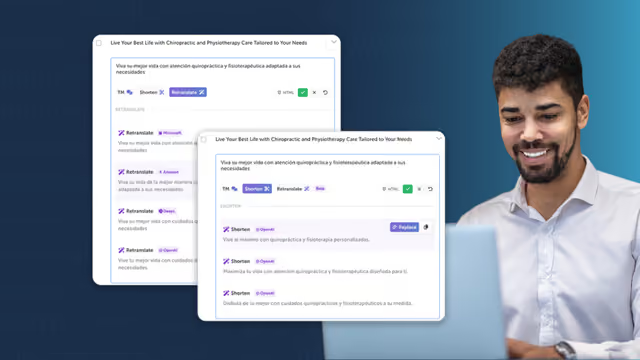
- Multi-engine orchestration, so you can route content based on observed performance rather than legacy defaults.
- Automated Translation Quality Scoring (TQS), providing continuous visibility into quality trends and early signals of regression.
- Blind-study-informed routing logic, grounded in real evaluation data rather than assumptions or reputation.
- Continuous evaluation and adjustment, so routing decisions evolve alongside models and language-specific performance.
Just as importantly, Localize supports strategic human involvement, not blanket review. It combines automated evaluation with configurable quality gates so that your team can focus human effort where it adds more value: high-impact content, edge cases, and validation.
Taken together, these capabilities reflect the core lesson of the study: improving translation quality at scale isn’t about chasing the latest model. It’s about building workflows that can measure performance, respond to change, and maintain consistency as the AI landscape continues to shift.



%20(1).jpg)