
Traffic is one of the easiest signals to reach for when deciding where to localize next. And it’s easy to understand why. You can see how much interest each page is generating, and where those views are coming from.
But for localization, traffic as a primary metric can turn into a trap. One day you realize you have a lot of traffic coming in from Germany. You instantly think, “We must localize for Germany!” After all, if there are many viewers, that’s a goldmine of potential customers, right? Not always.
A country may show up in analytics because people are curious, researching, or landing on one high-ranking English page. That doesn’t mean the market has buying intent, revenue potential, operational readiness, or enough strategic value to justify localization.
Traffic can tell you where attention is coming from. It can’t tell you where localization will create the most business value.
The 4 questions that matter more than traffic data
Traffic matters, but it’s not the first thing to consider. Instead, there are four critical questions you should answer before you decide where to localize first.
1. Is this market showing buying intent?
A market with an active sales conversation beats one with three times the traffic and no pipeline.
Traffic can show interest, but buying intent shows that visitors are closer to becoming customers.
Look for signals that connect traffic to action:
- Are visitors from this market reaching high-intent pages, such as pricing, demo, product, or comparison pages?
- Are they taking commercial actions, such as requesting demos, submitting contact forms, starting trials, or entering sales conversations?
- Are existing customers asking to expand usage into this market or requesting localized resources?
If several of these signals show up consistently, the market may be worth a closer look.
You can also look for lost opportunities due to language friction. If visitors from a specific market are reaching demo, pricing, or product pages but dropping off before they convert, language may be one of the barriers worth investigating.
2. Can this market realistically turn into revenue?
Some markets are interesting but not commercially ready. Others may have less traffic but a clearer path to revenue.
Look at things like:
- Is the market commercially large enough to matter? Look at whether there are enough right-fit companies, enough SaaS spend, and enough ICP-fit buyers to justify the investment.
- Is the category mature enough for buyers to act? Buyers may be curious, but that does not mean they understand the problem, have budget for the solution, or are ready to compare vendors.
- Can buyers purchase and adopt the product without major friction? Pricing, procurement, compliance, payment expectations, local workflows, and your own GTM coverage can all affect whether interest turns into revenue.
In other words, ask yourself, “can we actually convert, serve, and grow customers here?”
3. Can the business support the market after launch?
Localizing enough to attract a buyer but not enough to convert or support them is the fastest way to damage trust in a new market.
So, before prioritizing a market, ask yourself:
- Can sales follow up with leads from this region?
- Can customer support handle common questions?
- Are key onboarding and help resources ready?
- Are there legal, privacy, accessibility, or compliance requirements?
- Who will maintain translation quality after launch?
You don’t need to have every asset fully localized from day one. But you should be able to support potential customers at critical moments, so your localization strategy can create measurable value.
4. Is the opportunity worth the localization effort?
Some markets look attractive until you compare the potential upside with the effort required to launch and maintain them.
A large market may come with heavy competition, complex regulations, or high support needs. A smaller market may be easier to enter, especially if it has strong SaaS adoption, clear buying intent, and limited localized competition.
Look at factors like:
- Market size: Are there enough right-fit customers to justify the investment?
- Language reach: Would this language help you reach one market or several?
- Competitive pressure: Are localized competitors already setting buyer expectations?
- Regulatory complexity: Are there local requirements that could slow launch?
- Localization complexity: Will the language, content volume, or review process be difficult to maintain?
The goal is to choose a market where the potential return is strong enough to justify the operational lift.
How to align market selection with business goals
Localizing for localization’s sake or because you believe a market has potential based on traffic will only get you so far. More important is to choose a market that reflects what your business actually needs right now.
Localization for growth
If your goal is net-new revenue, you're looking for markets where demand exists but your product isn't accessible yet.
There are two signals to look for here.
- People who showed an interest in your product, but haven’t purchased anything yet.
- Competitors who are already localized in this market.
Growth-oriented market entry requires the most upfront investment: localized marketing pages, in-app experience, and at least basic support coverage. You can't just translate your homepage and call it a day.
Imagine a German logistics manager finds your SaaS tool, clicks around a German-language landing page, likes what they see, and books a demo.
The demo is in English, the pricing page is in English, and when they sign up, all the onboarding emails are in English. In most cases, at the end of the free trial, they’ll cancel. You localized enough to attract them, but not enough to keep them.
Localization for retention
This time, you already have some customers in a certain market, even before you localize. But when adoption stalls or renewals become harder, the issue is not always the product itself. Sometimes the friction comes from language, onboarding, support, or regional expectations.
Look for markets where:
- Support volume is increasing.
- Product usage is lower.
- Strategic accounts want to expand usage across countries.
- Churn or renewal risk is due to poor user experience.
Retention-focused localization is often faster to justify because you can measure the ROI against existing contracts, instead of just a hypothetical pipeline.
Localization for operational efficiency
When you’re at the early stages of your localization journey, the first market can work as an operational test. Many teams find themselves doing manual localization work, exporting files, coordinating with translators, and reinserting content.
A team that spends three weeks exporting strings, emailing translators, and manually reinserting content for one market will struggle to scale that process to five. That is why the first market should test the workflow, not just the opportunity.
Choose a market where you can build repeatable workflows. Efficiency-driven localization means replacing broken internal processes, so the market selection criteria shifts toward volume, update frequency, and how easily the team can maintain localized content over time.
Knowing which of these goals you're solving for changes everything about how you prioritize. A market that makes sense for growth may be the wrong call if your actual problem is churn.
Prioritize pages and user journeys, not just content volume
Once you know which goal you’re solving for, the next question is which pages actually move the needle.
Ask yourself: what does a prospect or customer from this market need to see and understand to take the next step? That path is usually much shorter than the sitemap suggests.
Map the journey before you touch the content
Before localizing a single page, trace the path a prospect actually takes. In most SaaS businesses, that looks something like: search result or ad → landing page → product or pricing page → sign-up or demo request. That is often only four to six critical touchpoints.
If any step in that journey breaks down because the content is in the wrong language, you've lost them.
Imagine someone stumbles upon a localized homepage, likes what they see, wants to learn about the product, but faces a pricing page in a different language. The chances of that turning into a conversion aren’t great. Make sure the critical path is localized before you launch the market.
Focus your first pass on high-impact pages
Once you've mapped the journey, localize the pages that do the most work:
- High-intent landing pages: the pages prospects hit from search, paid campaigns, or direct outreach.
- Pricing and comparison pages: where the final decision gets made.
- Key onboarding flows: what a new customer sees in their first session.
- Support documentation for your highest-volume issues: so you're not creating a support burden the moment you launch.
This gives you a functional, conversion-ready experience without requiring a full-site overhaul.
Expand based on what the market tells you
The market will tell you what to localize next if you're paying attention.
After launch, let performance data guide the next phase.
- Which pages are getting traffic but not converting?
- Where are users dropping off?
- Are support tickets spiking around a particular topic that isn't documented in the local language?
That feedback loop is healthier than trying to predict everything upfront, and it keeps your localization investment tied to real evidence rather than assumptions.
A simple scoring matrix for evaluating markets
If you're weighing multiple markets and need a way to compare them systematically, a lightweight scoring framework helps cut through the debate.
Score each candidate market from 1 to 5 on the following dimensions:
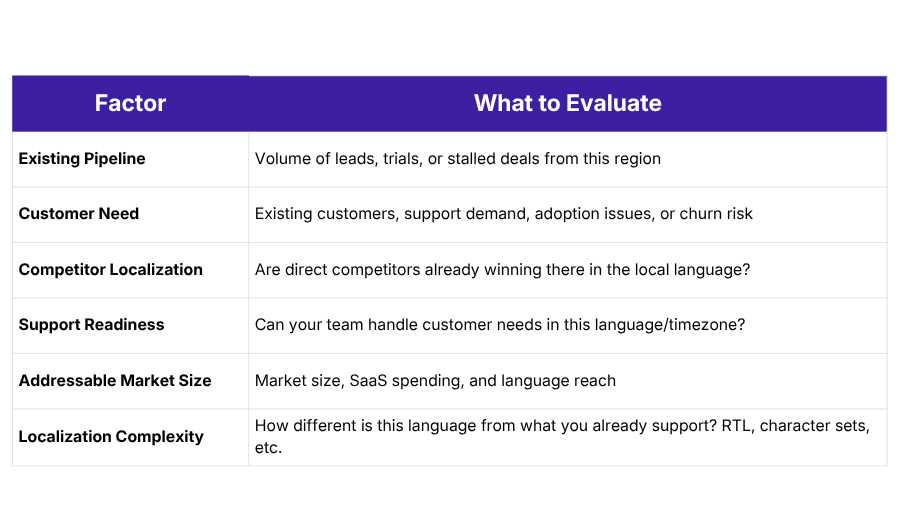
Add the scores. You’ll see that the markets at the top of the list won’t always be the ones with the most traffic, though they will be those where your investment can return measurable business outcomes.
This matrix won't make the decision for you, but it creates a shared language for the conversation across sales, product, and marketing teams. That alignment is often more valuable than the scores themselves.
Ready to make your localization investments work harder?
The teams that get market selection right aren’t the ones that move fastest. They’re the ones that ask the right questions before committing resources.
Which market has real buying intent? Where can interest realistically become revenue? Can the business support the market after launch? Which pages or journeys will actually move the needle?
Answering those questions first helps teams avoid investing in markets that look promising in analytics but are not ready to return measurable value.
If you’re working through this decision now, book a strategy session with the Localize team to talk through your market priorities and build a localization plan that can scale.