If your team localizes websites and web apps, the best Smartling alternative is Localize. It translates your site with one JavaScript tag and delivers updates to the live site without a new release. Smartling remains strong for large enterprises that need managed human translation at scale and document-heavy workflows.
Most teams start comparing Smartling alternatives when content outpaces the workflow. Marketing pages and app strings change every week. Each change can turn into a developer ticket and a review cycle that holds up the launch.
That delay matters because you're competing with content teams already publishing in your key markets. According to W3Techs content language statistics, English is the source language for 49.5% of websites. This shows about half of the web is published in additional languages you could be targeting.
This guide compares Localize and Smartling on five criteria: setup and developer effort, AI translation with human review, integrations, security, and pricing. Every product detail comes from each vendor's own website, reviewed on October 9, 2026. Localize publishes this guide, so anything Smartling hasn't published is marked "Not published" or "Unconfirmed" instead of guessed.
Evaluation framework: what to look for in a Smartling alternative
Switching platforms changes how every team ships multilingual content, so judge each option by the workflow it creates. If you're new to the category, start with what a translation management system does before you compare vendors.
The workflow matters because buyers expect content in their own language. The CSA Research language preference survey, a 2020 consumer study, found that 76% of online shoppers prefer product information in their native language. The same survey found that 40% will never buy from websites in other languages.
Those numbers describe consumers in 2020, so treat them as context for B2B buyers. With that context, use these questions to score each vendor:
- How much developer effort does setup take, and how much does each content update take after launch?
- How does AI translation combine with human review, and can reviewers see translations in context?
- Does the platform connect to the CMS and help center tools your teams already use?
- Can you verify security with a SOC 2 report, plus HIPAA support if you handle health data?
- How predictable is pricing as your word volume and language count grow?
Developer effort comes first because it repeats with every update, long after setup is done. Question two matters because more translation providers now post-edit machine translation. In Nimdzi's LSP survey, post-editing adoption rose from 26% in 2022 to nearly 46% in 2024, according to Nimdzi MTPE adoption data.
For question four, the AICPA SOC 2 description criteria define the report as an examination of controls over security, availability, processing integrity, confidentiality, and privacy. Ask each vendor for the full report during evaluation.
Comparison overview
This Smartling alternatives guide is a head-to-head on website and web app localization. It covers setup, AI and human workflows, integrations, security, and pricing. It leaves out multimedia and video localization, along with full language service provider comparisons.
Smartling is a fast-growing vendor, so any alternative has to hold up against real strengths. Nimdzi Insights' 2026 Nimdzi 100 report lists Smartling with $96.7 million in 2025 revenue and 93.4% growth. Where either vendor hasn't published a detail, the sections below say so.
Localize: website-first localization platform
According to its website and web app localization page, Localize sets up in less than 10 clicks with one JavaScript tag and translates websites and apps 80% faster. The same product page reports more than 40,000 users. The same page also says Localize detects new and changed content automatically and delivers translations to your live site without a new release.
As a Smartling alternative, Localize fits B2B SaaS teams that localize web and help content, where marketing and product need to ship without developer tickets. How Code.org scaled localization shows the result: cycle times fell by more than 50%, and 1–2 week publishing delays disappeared without new headcount. Here's how the core capabilities work:
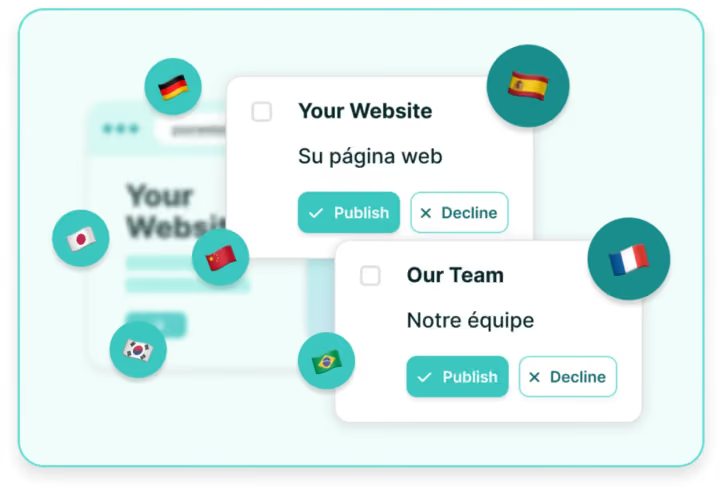
- Reviewers edit and preview translations on the page, and the Localize vs Smartling comparison says Localize supports language subdirectories with hreflang automation for SEO.
- Localize AI translation tools pair built-in machine translation engines and integrated LLMs with human review in context.
- The Localize AI Agent orchestrates the workflow, and Localize says every AI decision is "auditable, explainable, and adjustable."
- The Localize integrations directory lists WordPress, Webflow, Drupal, Zendesk, ReadMe, and React-based apps.
- You can translate your Webflow site without hard-coding translations or managing translation files.
- Localize security and compliance covers SOC 2 and HIPAA, plus an annual penetration test and a HackerOne bug bounty program. The same page lists SAML SSO and audit logs for access control.
- Cisco Meraki localized its dashboard in 13 languages with Localize and extended human-translated Japanese content to nearly 200 help articles.
Pros and cons
Pros
- One JavaScript tag handles setup in less than 10 clicks.
- New and changed content is detected automatically and delivered to the live site.
- AI translation and in-context human review run in a single workflow.
- GDPR, SOC 2 compliance and HIPAA support suit teams in regulated industries.
- Customer stories name the companies, including Code.org and Cisco Meraki, and report specific outcomes.
Cons
- Pricing is quote-based, and Localize doesn't publish per-word rates.
- Localize focuses on web and help content, so document-heavy programs and managed human translation at scale fit Smartling better.
Smartling: enterprise translation platform with built-in services
Smartling describes itself as "End-to-end localization & translation services for global growth." Smartling's company overview says Smartling was named a Leader in The Forrester Wave: Localization Services, Q3 2026. Smartling is best for large enterprises that want technology plus managed translation services across many content types, including documents.
For websites, Smartling's Global Delivery Network is a translation proxy that Smartling says "continuously crawls your site" with a 99.99% uptime guarantee. The same page says the proxy translates dynamic and JavaScript elements and supports translated URLs for SEO. The same page also says Smartling offers tools to prevent "bleedthrough" of untranslated content, such as a staging server or caching.
Beyond the proxy, Smartling also connects through CMS integrations or a custom API. Here's what the platform includes:
- According to Smartling's translation management system page, the TMS includes unlimited users at no extra cost and quality tooling built on the MQM framework.
- Smartling's homepage lists an LQA Agent scoring against MQM, "Auto Select LLM," bring-your-own AI models, and 50+ pre-built integrations (WordPress, AEM, Contentful, Sitecore, Zendesk). The same page lists formats such as JSON, XML, YAML, PDF, and SRT/VTT.
- According to Smartling's AI translation solutions page, the AI Hub connects 15+ MT engines and LLMs, though other Smartling pages cite up to 20+.
- Smartling's professional translation network includes 4,000+ linguists. Smartling's translation services come with a 100% satisfaction guarantee and fixes at no extra charge.
- According to Smartling's security page, Smartling complies with PCI, SOC 2, HIPAA, GDPR, several ISO standards, and HITRUST e1. The same page notes that security documents and reports are available upon request.
Pros and cons
Pros
- Smartling publishes per-word rates and offers a free Core plan.
- Integrations and file format support are broad, with 50+ pre-built connectors.
- A network of 4,000+ linguists comes with a 100% satisfaction guarantee.
- The compliance list is deep, including PCI Level 1, SOC 2, HIPAA, GDPR, ISO standards, and HITRUST e1.
Cons
- The Core plan keeps translation memory for only 180 days and limits workflow customization.
- Smartling doesn't publish an Enterprise subscription price.
- Some connectors need a third-party pricing tier or add-on, such as Builder.io's growth tier or the WordPress Multilingual CMS add-on.
- The proxy approach means you manage bleedthrough of untranslated content with staging or caching tools.
- Security documents and reports are available only on request.
Side-by-side comparison: Localize vs Smartling
Smartling publishes per-word rates, so older claims that its pricing is opaque are out of date. Smartling's published plans list rates starting at $0.0075 per word for machine translation and $0.20 per word for human translation. Enterprise subscriptions still require a sizing conversation with Smartling's team.
Localize takes a quote-based approach instead. The Localize pricing options page says Localize can reduce developer effort by up to 70%. The same page says quotes depend on languages, projects, pageviews, content volume, and how often your website or app changes.
Read the table by your main constraint. If developer time is scarce, start with the website implementation and content detection rows. If procurement drives the decision, start with security and pricing, then request the documents each vendor offers.
Selection guidance: how to choose
The table narrows the field, and a pilot on your own content settles the decision. Run both vendors through the same test so you compare real workflows instead of feature lists.
If you're already on Smartling, plan the migration before the pilot starts. Export your translation memory and glossaries first, since the Core plan keeps translation memory for only 180 days. Then work through this checklist with both vendors:
- Run a pilot on a live set of pages, including at least one page that changes weekly.
- Track developer hours for setup and for each content update during the pilot.
- Publish new and edited content, then check how quickly each platform detects it.
- Have your own reviewers check AI output in context on the page.
- Request each vendor's SOC 2 report, plus HIPAA documentation if you handle health data.
- Model cost with your real word volume, using Smartling's per-word rates and a Localize quote.
- Confirm you can export translation memory and glossaries, and check how long each plan retains them.
Score the pilot results against the five questions in the evaluation framework. The platform that keeps developer hours low while your reviewers stay in control is the one that will keep pace as your content grows.
Verdict: which should you choose?
Both platforms are credible, and the right one depends on the content you translate most. Choose Smartling if you need managed human translation at scale and document-heavy workflows, or if your security team wants the widest compliance list. Its published per-word rates and free Core plan also make it easy to start small.
Choose Localize if your priority is web and help content that changes every week. One JavaScript tag lets marketing and product ship translations without developer releases, and AI translation runs alongside human review in context.
If your search for Smartling alternatives started because developers get pulled into every update, Localize is the better fit. Run the pilot checklist above with your own pages and reviewers, then compare the results side by side.