In this post, we’ll compare what the evidence says about the top LLM options for translation and how to fit them into your localization workflow.
If you’ve read the news lately, you’ve probably heard that AI translation technology is advancing fast. Large Language Models (LLMs) like ChatGPT, Claude, and Gemini are surprisingly good at capturing tone and intent in translations. In the WMT26 machine translation findings, from the annual shared task run by the Conference on Machine Translation, the best overall system was Wayfinder, a pipeline built on LLMs including Gemini 3.1 Pro and GPT-5.5. It reached the top cluster in 17 of 23 language pairs.
We ran side-by-side comparisons using common translation challenges to see how these LLMs perform in real-world business scenarios. The results were eye-opening: while each model showed strengths, they differed most in accuracy and in how well they handled context.
Below, we break down what the benchmarks show for each option and how to choose.
Are LLMs better than traditional machine translation?
In the WMT26 shared task, 27 of 30 submissions used LLMs, and the top three systems were all built on Gemini. The two approaches work differently, though, and those differences decide where each one fits. Here’s a quick look at how AI translation works for each.
- Neural machine translation (NMT) uses an encoder-decoder model trained on parallel text, meaning source sentences paired with their translations.
- NMT is fast and deterministic, so the same input returns the same output every time.
- LLMs train on broad text, which helps them handle tone and idioms. They’re also better at resolving ambiguous phrasing.
- LLMs are non-deterministic and can mishandle placeholders and HTML tags, which matters when you ship UI strings.
That last point deserves attention from engineering teams. If your strings contain variables such as {username} or inline tags, a non-deterministic model can return a different result on each run. You’ll need checks that confirm every placeholder and tag survives translation before anything ships.
On overall quality, though, the shared task results favor LLMs. In the WMT26 findings, the strongest off-the-shelf model in the test was Gemini 3.1 Pro, which reached the top cluster in 15 of 23 language pairs. Human reference translations reached the top cluster in 8 of the 12 pairs that had them. The paper notes several references were post-edited from model output.
Our own testing points the same way. In Localize’s blind AI translation study, LLM engines outperformed traditional neural machine translation across all languages we tested. LLMs handled context across sentences more reliably, while traditional MT systems tended toward literal, sentence-by-sentence translations.
So LLMs have the edge on context and nuance, and NMT keeps its edge on speed and predictability. Match each approach to the content it suits, and plan for human review where errors are costly. That review step is where LLMs on their own fall short.
Why translations from LLMs aren’t enough
LLMs have changed the game for translation. They understand tone and cultural nuance, but they’re not perfect.
That’s why Mozilla’s Pontoon localization tool offers LLM output as suggestions to human localizers and feeds terminology matches into its prompts. In our experience, accuracy and brand integrity still require a human check.
But speed and nuance aren’t the only concerns. There are other limitations that businesses need to consider.
Fluency ≠ accuracy
LLMs are remarkable at human-like AI translations, but a translation that sounds good can still be completely wrong. In high-stakes content like legal docs or product UIs, even a small error can confuse users or put your brand at risk.
The WMT26 findings add two warnings. In a hallucination test suite, general-purpose LLMs were far more prone to failures than dedicated MT systems. For the low-resource languages the paper highlights, most systems scored 60 or below out of 100. Quality also shifts over time: in Localize’s June and September tests, some engine and language pairs improved while others declined.
Limitations for file uploads
Uploading files like HTML for an LLM to translate doesn’t always work well. OpenAI’s ChatGPT file upload limits cap each file at 512MB and text documents at 2 million tokens, and OpenAI notes it may lower limits during peak hours. Large or complex files can reduce the accuracy of any model’s output. While LLMs are powerful, they still struggle with intricate documents and files.
Privacy concerns
Most LLM users don’t realize how complex data privacy becomes behind the scenes. As these models power more everyday tasks, including translation and code generation, the risks of unauthorized data sharing and personal data exposure are growing fast.
The problem of scaling for business
No one can argue how easy it is to paste a quick phrase into ChatGPT and get a fluent translation. But scaling is different. What about dozens of landing pages and mobile apps? LLMs alone don’t scale well to fit complex business needs.
Top LLM options for translation in 2026
In its 2024 guidance, Microsoft adds that LLMs perform well for translation, especially for high-resource languages.
No single ranking holds across every language and content type, so this section groups the leading options by what the evidence shows. Gemini and GPT lead the latest independent human evaluations, while Claude scored well in Localize’s own tests but has thinner recent independent data. Qwen and DeepSeek are options worth testing.
Whether you're building multilingual apps or localizing a marketing site, LLMs can help, but they’re best used as a supplement.
In 2025, the Localize Team tested ChatGPT-4, Claude 3, and Gemini 1.5 to see how they compare. All three vendors have since shipped newer models. OpenAI’s latest model is GPT-6.1 Sol, according to OpenAI’s GPT-6 announcement. Anthropic’s current Claude lineup includes Claude Fable 5.1, its highest-priced model, alongside Opus 5.5 and Sonnet 5.5. Google’s Gemini API model list calls Gemini 4 Argon its flagship reasoning model. Treat our scores as a snapshot and re-test before you commit.
Independent benchmarks for Claude are thinner. WMT26 didn’t test Claude on its own. In the WMT25 shared task findings, Claude-4 averaged a human-evaluation rank of 6.62 across 16 language pairs, behind Gemini 2.5 Pro (2.28) and GPT-4.1 (4.40). It still placed near the top for Czech to German and English to Chinese. Those 2025 results cover Claude 4, so they don’t show how Claude Opus 5.5 or Sonnet 5.5 translate.
Alibaba’s Qwen is worth watching too. Qwen 3.7 Max is one of four models inside Wayfinder, the top WMT26 system. WMT26 didn’t test it on its own or show how much it contributed. Qwen was the most common base model among WMT26 submissions (9 of 30). Lumen, a fine-tuned system built on smaller Qwen models, reached the top cluster in 13 of 23 language pairs. Alibaba’s wen3.5 model card says Qwen3.5 supports 201 languages and dialects.
How the top options scored in Localize’s tests
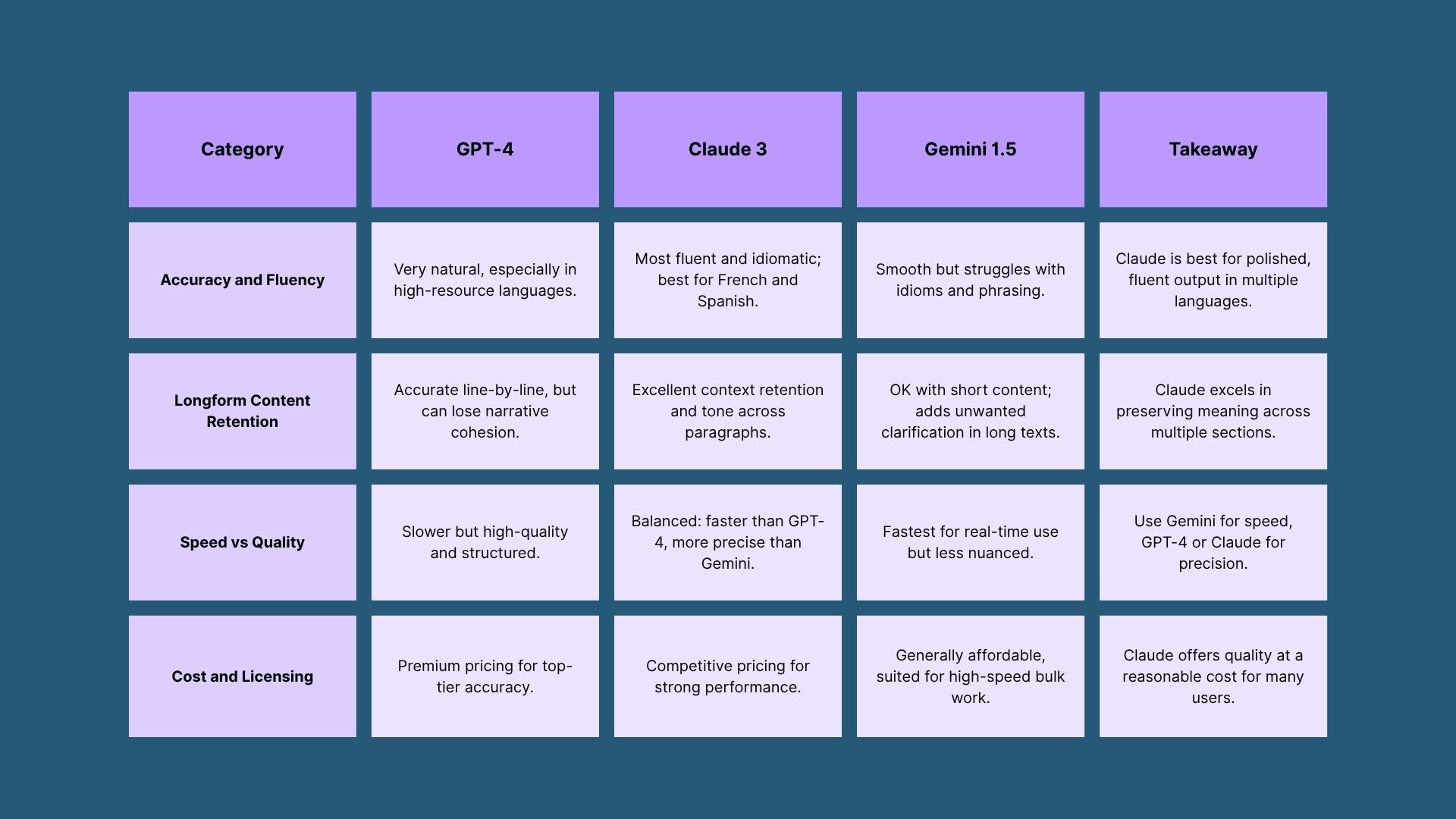
For a broader view, our blind AI translation study compared LLMs with traditional MT engines. Native linguists scored about 40 phrases in six languages: Spanish, French, Japanese, Italian, German, and Chinese. They rated fluency and accuracy, and checked whether each translation preserved the original meaning.
September 2025 scores from Localize’s blind AI translation study.
OpenAI and Claude led the field. In our study’s general-content test set, LLMs showed particular strength in Japanese, Chinese, and Italian. Google’s LLM variants trailed with only modest gains over Google NMT. Results on your own domain content may differ. Claude delivered top-tier performance at the lowest cost per character ($0.25 per 50,000 characters).
What about DeepSeek and open-weight models?
DeepSeek is worth testing as a lower-cost option where your quality needs allow, or if you want to self-host open weights. Localize hasn’t tested DeepSeek in our blind study, so the figures below come from outside sources.
In the WMT26 findings’ overview of average rankings, DeepSeek V4 Pro (run with reasoning on) placed around 17.5, well behind Gemini 3.1 Pro (4.8) and GPT-5.5 (8.6). For English to Czech it scored 56.6, against 77.1 for GPT-5.5. Based on July 2026 prices, its estimated cost for the test set was $41.5, against $133.5 for GPT-5.5 and $251.7 for Gemini 3.1 Pro.
As of October 2026, the DeepSeek API pricing page lists DeepSeek-V4.1-Flash at $0.15 per million input tokens (cache miss) and $0.60 per million output tokens off-peak. DeepSeek says off-peak rates are half of peak rates and that it may adjust prices, so check the page before you budget.
Be careful with DeepSeek’s own app and services. In January 2025, the Italian data protection authority, known as the Garante, ordered a limitation on processing Italian users’ data by the DeepSeek chatbot. DeepSeek’s privacy policy also says it stores data from its own consumer services in the People’s Republic of China.
If you reach DeepSeek models through another platform, data handling depends on that route. According to OpenRouter’s DeepSeek provider guide, OpenRouter served DeepSeek V4 Pro through 16 providers as of July 2026, including DeepSeek itself. If location matters, use OpenRouter’s options to pin or exclude providers, and check each chosen provider’s own data terms. For DeepSeek-R1, AWS says in its DeepSeek on Amazon Bedrock announcement that inputs and outputs aren’t shared with model providers.
Self-hosting changes where your data goes. DeepSeek licenses the V4-Pro weights under the MIT License, according to the DeepSeek-V4-Pro model card on Hugging Face. Running them keeps data on your own infrastructure, but V4-Pro has 1.6 trillion total parameters, so self-hosting it is a serious infrastructure commitment.
How to choose the right LLM for your translation workflow
Our blind study found that no engine excelled universally. Scores varied by language and shifted between our June and September tests. So the useful question is which engine fits each type of content, and how you’ll catch problems when quality changes.
The study points to four practical steps.
1. Start with a content risk assessment
Sort your content by what a translation error would cost you. Tag each content type, such as legal pages, marketing copy, help articles, and UI strings. A mistranslated legal clause carries more risk than an awkward button label. Localize’s study found traditional MT engines still play an important role for high-volume, low-risk content such as structured UI strings.
2. Combine AI with human review strategically
Put human reviewers where they matter most. The study found human oversight remains critical for legal and regulatory content and for sensitive brand messaging. For lower-risk content, the reviewer’s role shifts to governing and validating already-strong outputs. Decide up front which content types always get a full review and which get spot checks.
3. Automate engine selection and quality gates
Route each content type to the engine that performs best for it, and set a quality threshold that flags weak translations for review. One way to apply those gates is Localize’s Translation Quality Score, which brings AI translation quality scoring into your workflow. Give each LLM explicit context too, since Microsoft notes LLMs perform better with it.
4. Continuously measure and adapt
Engines improve and regress unpredictably, so re-test on your own content on a regular schedule. The engine that led your last test may trail after its next update. Keep a fixed test set of your own strings in each target language, and score every candidate engine against it when vendors ship new models.
Running these steps by hand across many engines and languages takes real engineering time. That’s the gap Localize is built to close.
Make the most of LLM translation with Localize
LLMs are powerful, but choosing the right one and managing it yourself isn’t always the best path. Especially when translation accuracy and quality matter.
Localization takes more than a smart model. It requires the right infrastructure and quality controls.
That’s where Localize comes in.
Localize can help you tap into the power of LLMs without managing models and quality controls on your own.
The competitive advantages of Localize AI
Localize helps you move faster and scale globally without the usual bottlenecks. Our AI-first workflows take the guesswork out of localization.
Fast, automated translation with human-level quality
Localize integrates with industry-leading AI tools to instantly deliver high-quality translations.
- Localize detects new and updated content and submits it for translation automatically, so your whole site stays current.
- Built-in LLM features help you choose the best phrasing, add context, and shorten copy for better UX, without manual copy-pasting.
Built for any file format or front end
Localize adapts to your workflow, whether you're localizing a marketing campaign, mobile app, support content, or product UI.
- Works with file types such as JSON, HTML, and XML.
- Fits any web technology, CMS, mobile app, or API. It works anywhere you can install a JavaScript tag.
Speed at scale, without sacrificing accuracy
Localize helps thousands of companies launch in new markets, faster than ever.
- Automate tedious translation tasks while keeping your team looped in for review.
- Blend automation with professional translators or internal reviewers to fine-tune results from AI engines like DeepL.
Enterprise-grade security and compliance
Localize was built with security, so you can translate confidently, even if you work with sensitive or regulated data.
- We never share customer data, and we don’t use customer data to train AI models.
- Localize meets security standards including SOC 2, HIPAA, and Cloud Security Alliance (CSA) requirements.
Final thoughts on LLM translation
LLMs are changing how businesses approach translation. But even the best AI can’t replace the infrastructure and quality control that localization demands.
Localize bridges that gap. We combine the power of AI with the oversight and workflows teams need to move fast and stay accurate. Whether you're translating a single site or scaling to dozens of new markets, we make it easy to go global confidently.
Ready to take the complexity out of localization? Let’s talk.