Crafting content for an international audience takes more than a good translator.
Translation plays a vital role in getting your website, product, or service noticed abroad, but it's not always enough on its own. Sometimes you also need to localize, so your content feels culturally relevant to the people reading it.
But wait a minute... aren't translation and localization the same thing? Nope. Here's what actually separates them, with localization vs. translation examples and a framework for deciding which one your content needs.
Translation vs. Localization: The Difference at a Glance
The short version: translation changes the language. Localization changes the experience.

What Is Translation?
Translation is the process of converting written content from one language into another.
A translation project usually involves translators or language service providers (LSPs), companies that supply professional translators and manage translation projects for clients. Translators often work from a glossary and a style guide, two reference documents that keep terminology and tone consistent across every page. Many companies now pair human translators with AI translation to move faster, then have a person review the output before it publishes.
Example: Translation at Google
Google translates its help center into dozens of languages so international customers can get support in their own language, without waiting for a rewritten version of the site.
Compare the Urdu and American English versions of support.google.com. Aside from the language and text direction, the pages are the same: same layout, same images, same structure. That consistency is the point. A support article about resetting a password doesn't need cultural adaptation. It needs to be accurate and easy to find.
Example: Translation at Carry1st
Mobile developer Carry1st noticed low downloads in Arabic-speaking regions. It partnered with Localize to translate its website, and downloads from Egypt and Sudan grew as a result.
This is a true translation. The Arabic and English versions differ in language; the layout, imagery, and design stay identical.
When and Why You Should Translate
An estimated 63% of websites are in English. Only about 20% of the world's population can read and speak English. That gap is your opportunity: translating your site opens the door to the other 80%.
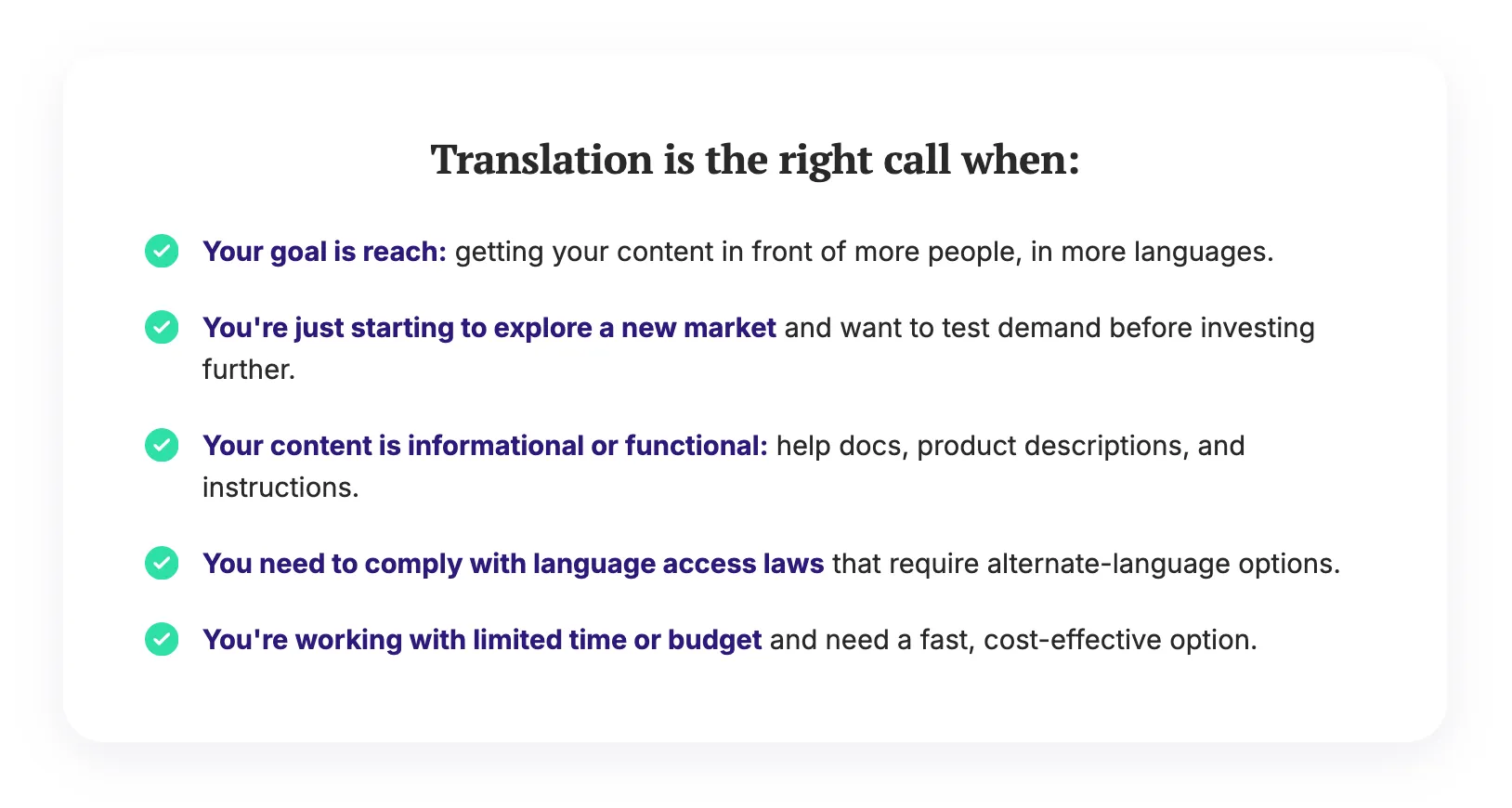
Hire a translator or LSP with real fluency in your target market's language. Literal, word-for-word translations, and unedited AI output, tend to read awkwardly at best and get facts wrong at worst. Post-editing (a professional review pass after AI translation) catches most of those errors. Even a technically correct translation can still miss the cultural context that makes content resonate with a reader. That's where localization comes in.
What Is Localization?
Localization is the process of adapting a product or piece of content to a specific target audience. Translation changes the words. Localization changes how well the product fits the culture it's landing in.
Localizing content means translating it, then adjusting it for the target audience's culture. That can mean new color schemes, different layouts, market-specific images, or even different product offerings, on top of the translated text.
Example: Localization at Nike
Nike sells in more than 160 countries, so localization matters at scale. Visitors to Nike's site first pick their location.
Select China, and the homepage looks nothing like the American version: different color scheme, different models, different layout, on top of the different language.

Example: Localization at Reddit
Reddit localized its entire platform, translating pages, communities, and forums into 13 languages, with more planned. Users can translate their whole feed, including posts and comments, with one tap.
Local moderators curate content for regional humor and interests on top of the translation, deciding which memes, references, and topics resonate in their community. Reddit's revenue outside the US grew 82% following the expansion, which suggests the localization work, not just the translated text, is doing real business work.
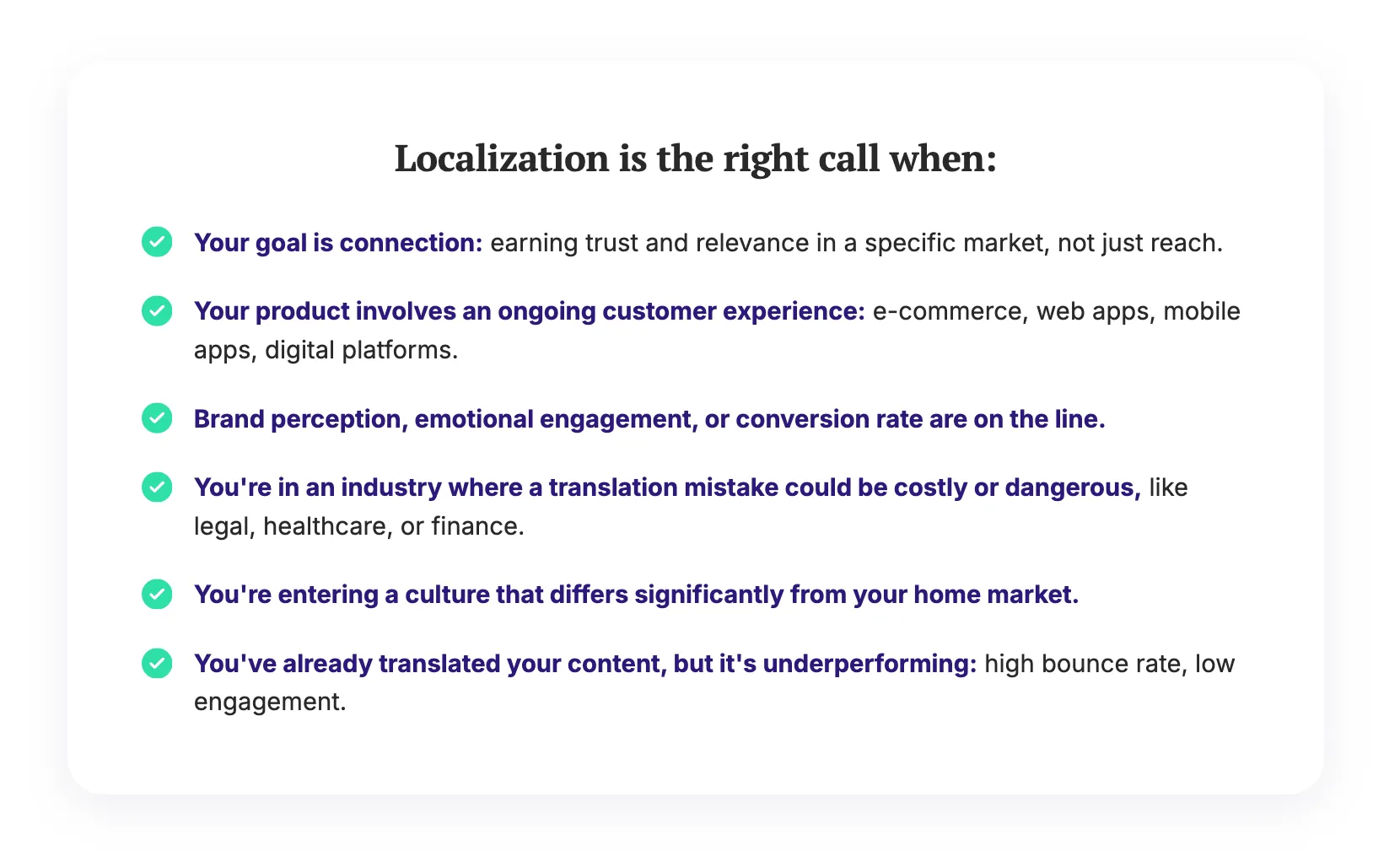
When and Why You Should Localize
Apple's "Get a Mac" ad campaign is a well-known localization case study. In the US, the ads pitted a cool, casual Mac against a stuffy, corporate PC, and sales rose 39% as a result.
A literal translation of those ads would have flopped in Japan, where audiences generally dislike combative advertising that puts down competitors. So Apple skipped translation altogether and used transcreation instead: recreating the message from scratch for the new culture, rather than converting it line by line. Apple hired two local comedians who could make the same point in a way that fit Japanese humor.
The Same Content, Two Treatments
The Google, Carry1st, Nike, and Reddit stories above are useful localization vs. translation examples, but each one compares two different companies. Here's the same line of marketing copy handled both ways, for a single US e-commerce brand expanding into France.
Original (US English): "Score a touchdown with our Fourth of July blowout — everything's 30% off, and orders over $50 ship free."
Translated literally (French): "Marquez un touchdown avec notre liquidation du 4 juillet — tout est à -30 %, et les commandes de plus de 50 $ sont livrées gratuitement."
This is a faithful, grammatically correct translation. It's also confusing for a French shopper: "touchdown" is an American football term with no local resonance, July 4th isn't a French holiday, and the price is still in dollars.
Localized (for France): "Marquez un but avec nos soldes d'été — tout est à -30 %, et les commandes de plus de 50 € sont livrées gratuitement."
The localized version swaps the sports metaphor for one that lands in France (marquez un but, "score a goal"), replaces a US-only holiday with a general summer sale, and converts the price to euros. Same offer, same discount. It reads like a French copywriter wrote it, instead of an American one running copy through a translator.
Localization vs. Translation: Which Is Right for Me?
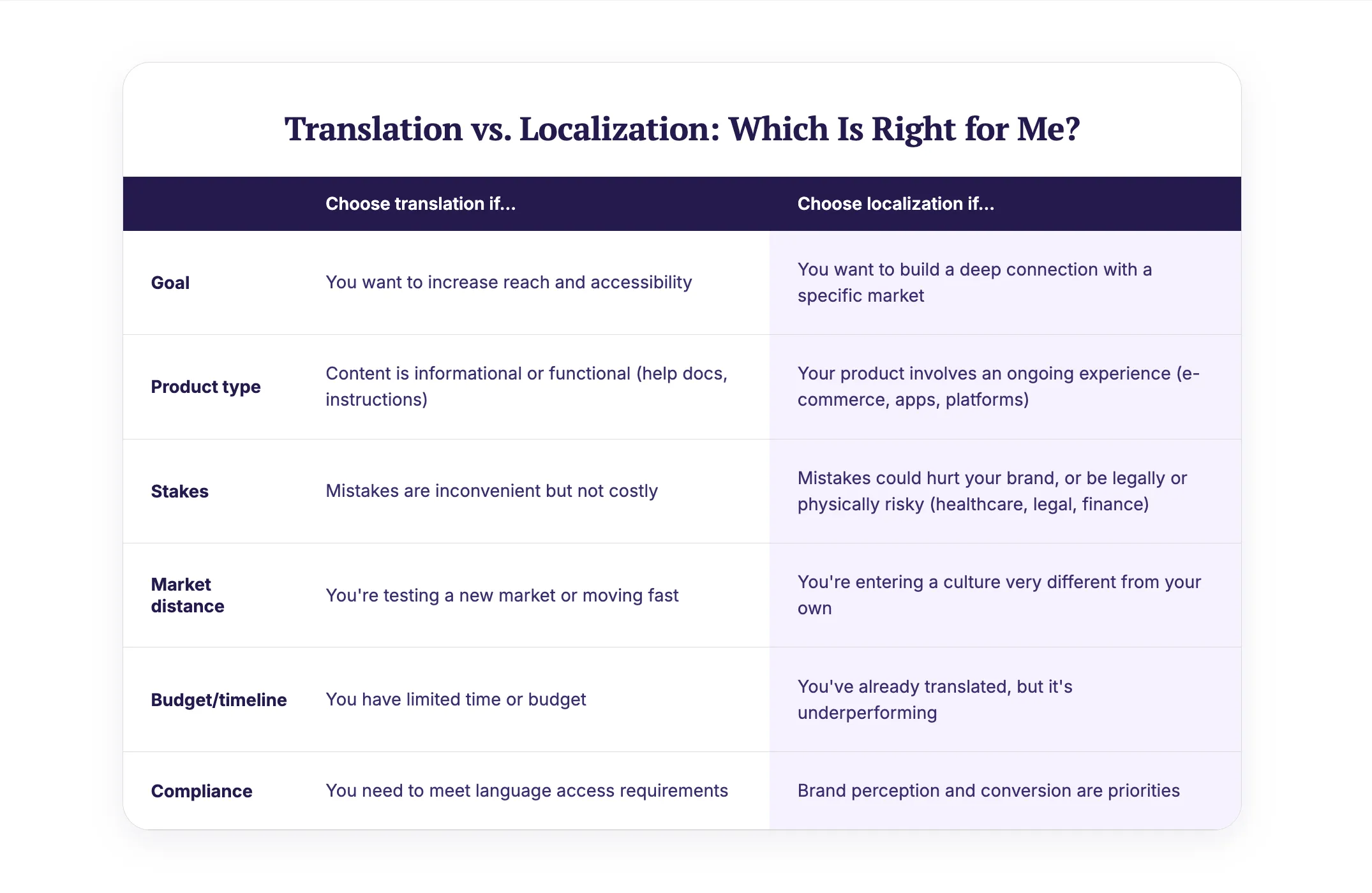
Most companies don't choose translation vs. localization once and stop. Translation is often the first step into a new market. Localization is what you add once you know that market is worth deeper investment, and once you've seen where a purely translated experience is falling short.
Recap: Two Different Jobs
Translation converts your words into a new language. Localization adapts your entire experience, words included, to fit a specific culture. They solve different problems at different stages of going global, and most companies need both eventually.
Once you know the difference between translation and localization, the harder question is how to act on it: which markets to prioritize first, and when translation is enough versus when it's time to localize. Our guide to building a content localization strategy walks through exactly that.
(For a broader look at everything localization covers beyond this comparison, see our full breakdown of what localization is. If you're also trying to place internationalization in the mix, see how translation, localization, and internationalization fit together.)